Croissant Costing Guide: Ingredient, Labor, and Lamination Time
Published: June 18, 2025
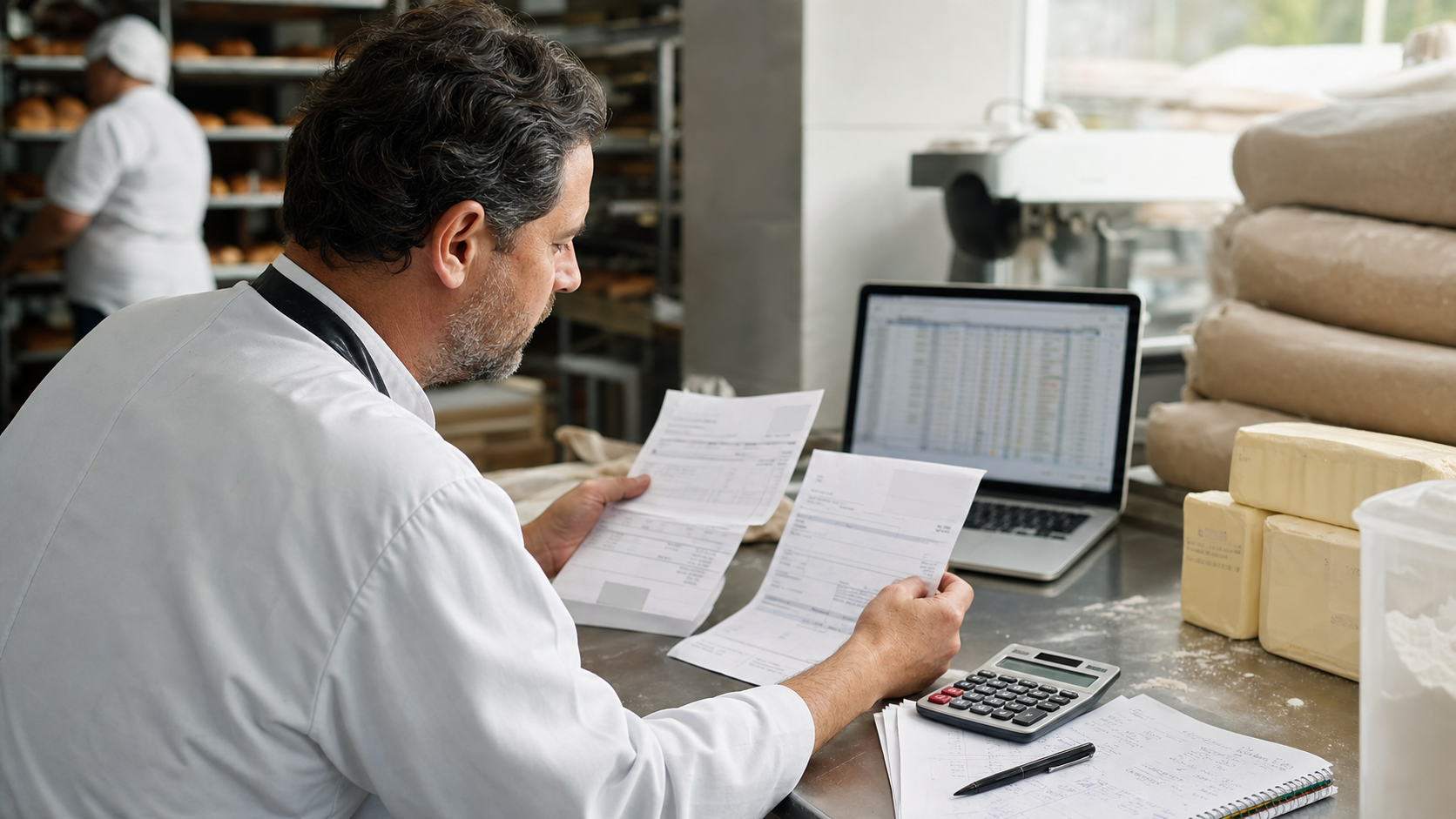
Everyone wants to sell croissants. Few people want to do the math on what they actually cost.
I get it. There's something painful about realizing that your beautiful, flaky, 27-layer croissant might be making you less money than your chocolate chip cookie. But until you face that number, you're guessing at pricing—and guessing gets expensive.
Let me walk you through how croissant costing actually works. Not the oversimplified version where you just add up ingredients. The real version that accounts for butter ratios, labor intensity, yield loss, and all the ways croissants are different from everything else in your case.
Why Croissants Are Different
Most bakery items follow a predictable costing pattern. Ingredients plus labor plus packaging plus overhead equals cost. Scale up production and your per-unit cost drops.
Croissants break this pattern in several ways:
Butter dominates ingredient cost: In most recipes, flour is your biggest expense. In croissants, butter can represent 40-60% of ingredient cost—and butter prices swing wildly.
Labor is front-loaded and skill-dependent: The lamination process takes hours of active and passive time. A new baker might take twice as long as an experienced one, with worse results.
Yield varies more than other products: A 5% yield variance on cookies barely matters. A 5% yield variance on croissants—given their higher per-unit value—hits hard.
Quality is binary: An under-proofed croissant or one with butter blowouts isn't "slightly worse." It's unsellable. Your effective waste rate is higher than for more forgiving products.
The Butter Question
Let's start with the biggest variable: butter.
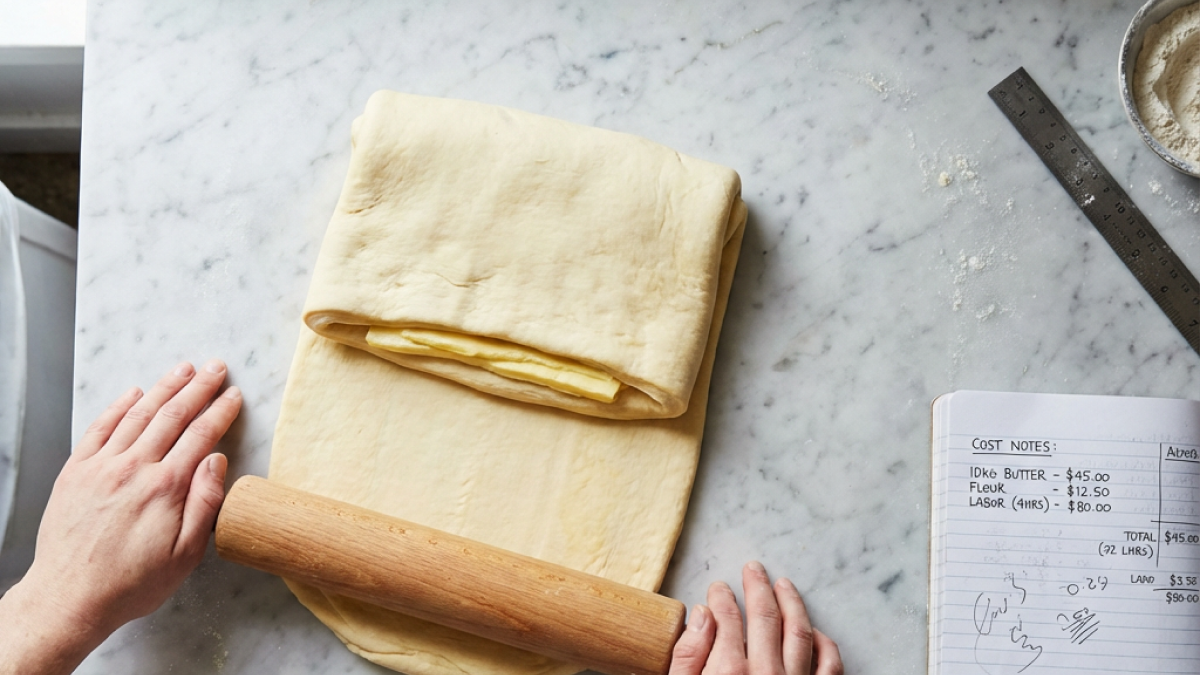
Traditional French croissant recipes call for a butter-to-dough ratio around 27-33% of total dough weight in lamination butter. That's on top of the butter in your détrempe (base dough).
Here's what that looks like in practice:
Base dough (détrempe) for 24 croissants:
- Bread flour: 500g
- Milk: 250g
- Sugar: 60g
- Salt: 10g
- Yeast: 12g
- Butter: 50g
Lamination butter block:
- Butter: 280g (using ~28% ratio)
Total butter: 330g Total dough weight: ~1,162g Butter as percentage of total: ~28%
Now let's price this. Butter costs vary enormously by quality and location:
| Butter Type | Price/kg | Cost for 330g |
|---|---|---|
| Standard unsalted | $6.50/kg | $2.15 |
| European-style (82%) | $9.00/kg | $2.97 |
| Premium (Plugrá, etc.) | $12.00/kg | $3.96 |
| French AOC | $18.00/kg | $5.94 |
The butter alone ranges from $2.15 to $5.94 for the same batch. That's a $0.16 to $0.25 difference per croissant just from butter choice.
Higher Butter Ratios
Some bakeries push butter ratios to 35-40% for maximum flakiness. Let's see what that costs:
At 35% ratio for the same batch:
- Lamination butter: 350g (up from 280g)
- Additional butter cost at $9/kg: $0.63
- Per-croissant increase: $0.03
At 40% ratio:
- Lamination butter: 400g
- Additional butter cost at $9/kg: $1.08
- Per-croissant increase: $0.05
That extra $0.03-0.05 per croissant might not sound like much, but multiply it by 200 croissants daily and you're looking at $150-250 extra monthly in butter alone. Whether that premium butter creates $150-250 in additional value (through higher prices or more sales) is the real question.
Full Ingredient Cost Breakdown
Let me cost out a complete batch using mid-range ingredients:
Détrempe:
| Ingredient | Amount | Price/kg | Cost |
|---|---|---|---|
| Bread flour | 500g | $0.75 | $0.38 |
| Whole milk | 250g | $1.10/L | $0.28 |
| Sugar | 60g | $0.90 | $0.05 |
| Salt | 10g | $0.50 | $0.01 |
| Fresh yeast | 12g | $8.00 | $0.10 |
| Butter | 50g | $9.00 | $0.45 |
| Subtotal | $1.27 |
Lamination:
| Ingredient | Amount | Price/kg | Cost |
|---|---|---|---|
| Butter block | 280g | $9.00 | $2.52 |
Egg wash (shared across batch):
| Ingredient | Amount | Price | Cost |
|---|---|---|---|
| Egg | 1 | $0.35 | $0.35 |
| Milk (splash) | 15g | $1.10/L | $0.02 |
| Subtotal | $0.37 |
Total ingredient cost for 24 croissants: $4.16 Per croissant: $0.17
Wait—$0.17 per croissant? That seems low. And it is, because we haven't accounted for yield loss yet.
Yield Loss: The Hidden Cost Multiplier
Theoretical yield: 24 croissants from this batch. Actual yield: Almost never 24.
Where does dough go?
Trimming loss (5-7%): The edges of your laminated dough aren't usable for croissants. You can repurpose some for pain au chocolat or scrap cookies, but those scraps don't have the same value.
Shaping waste (2-3%): Dough that sticks, tears, or gets misshapen during rolling and cutting.
Proofing casualties (2-4%): Croissants that don't proof evenly, collapse, or have visible butter blowouts before baking.
Baking loss (1-2%): Croissants that overbrown, underbake, or have other quality issues.
Let's say you're running a tight operation with 10% total yield loss. Your batch of 24 croissants actually yields ~21-22 sellable units.
Adjusted per-croissant ingredient cost: $4.16 ÷ 21 = $0.20
At 15% yield loss (common for newer operations): $4.16 ÷ 20 = $0.21
That $0.03-0.04 difference adds up to $700-1,000 annually for a bakery making 100 croissants daily.
Labor: The Real Cost Driver
Here's where croissant costing gets serious. Ingredient costs are actually the easy part.
Let's map out the labor for a batch of 24 croissants:
Day 1: Dough Prep
| Task | Active Time | Passive Time |
|---|---|---|
| Mixing détrempe | 15 min | : --- |
| Initial rest | : --- | 30 min |
| Shaping butter block | 10 min | : --- |
| Initial fold (lock-in) | 10 min | : --- |
| First rest (refrigerate) | : --- | 60 min |
| Second fold (single) | 8 min | : --- |
| Second rest | : --- | 60 min |
| Third fold (single) | 8 min | : --- |
| Overnight retard | : --- | 8-12 hours |
Day 1 active labor: ~51 minutes
Day 2: Shaping and Baking
| Task | Active Time | Passive Time |
|---|---|---|
| Final roll-out | 15 min | : --- |
| Cutting triangles | 10 min | : --- |
| Shaping | 20 min | : --- |
| Proofing | : --- | 90-120 min |
| Egg wash | 5 min | : --- |
| Baking | : --- | 18-22 min |
| Cooling | : --- | 30 min |
| Quality check/packaging | 5 min | : --- |
Day 2 active labor: ~55 minutes
Total active labor: ~106 minutes for 24 croissants Per croissant: ~4.4 minutes
At $20/hour loaded labor cost: Per-croissant labor: (4.4 ÷ 60) × $20 = $1.47
This is where most bakeries underestimate. They see "fold dough three times" and estimate 20 minutes total. They forget the setup, cleanup, monitoring, quality control, and inevitable interruptions.
Scaling Efficiency
Here's the good news: croissant labor scales better than most products.
| Batch Size | Total Labor | Per-Unit Labor | Labor Cost/Unit |
|---|---|---|---|
| 24 | 106 min | 4.4 min | $1.47 |
| 48 | 150 min | 3.1 min | $1.03 |
| 96 | 220 min | 2.3 min | $0.77 |
| 192 | 360 min | 1.9 min | $0.63 |
Doubling your batch size cuts per-unit labor by ~30%. This is why high-volume bakeries can sell croissants at prices that would bankrupt a small operation.
But equipment constraints matter. You can't make 192 croissants if your sheeter only handles 48-unit batches of dough. You can't bake 192 if your oven only holds 36. These constraints determine your actual production efficiency.
A Complete Cost Picture
Let me build out the full cost for our 24-croissant batch:
| Component | Total Cost | Per Croissant (21 yield) |
|---|---|---|
| Ingredients | $4.16 | $0.20 |
| Labor (106 min @ $20/hr) | $35.33 | $1.68 |
| Packaging (bags) | $2.10 | $0.10 |
| Overhead allocation | $5.25 | $0.25 |
| Total | $46.84 | $2.23 |
With this cost structure:
- Retail price of $4.00 = 44% margin
- Retail price of $4.50 = 50% margin
- Wholesale price of $3.00 = 26% margin
- Wholesale price of $2.50 = losing money
Using a Croissant Lamination Calculator
A proper food cost calculator should handle croissants' complexity:
Sub-recipe support: Your laminated dough should be a separate recipe that feeds into croissant, pain au chocolat, almond croissant, and any other viennoiserie using the same base.
Butter price tracking: When butter jumps from $6.50/kg to $9.00/kg (it happens), your calculator should update all affected recipes automatically.
Yield adjustment: Enter your theoretical yield and actual yield. The calculator should show both costs so you can see what yield loss is costing you.
Labor timing: The ability to input prep time, production time, and bake time separately. This helps identify where efficiency gains are possible.
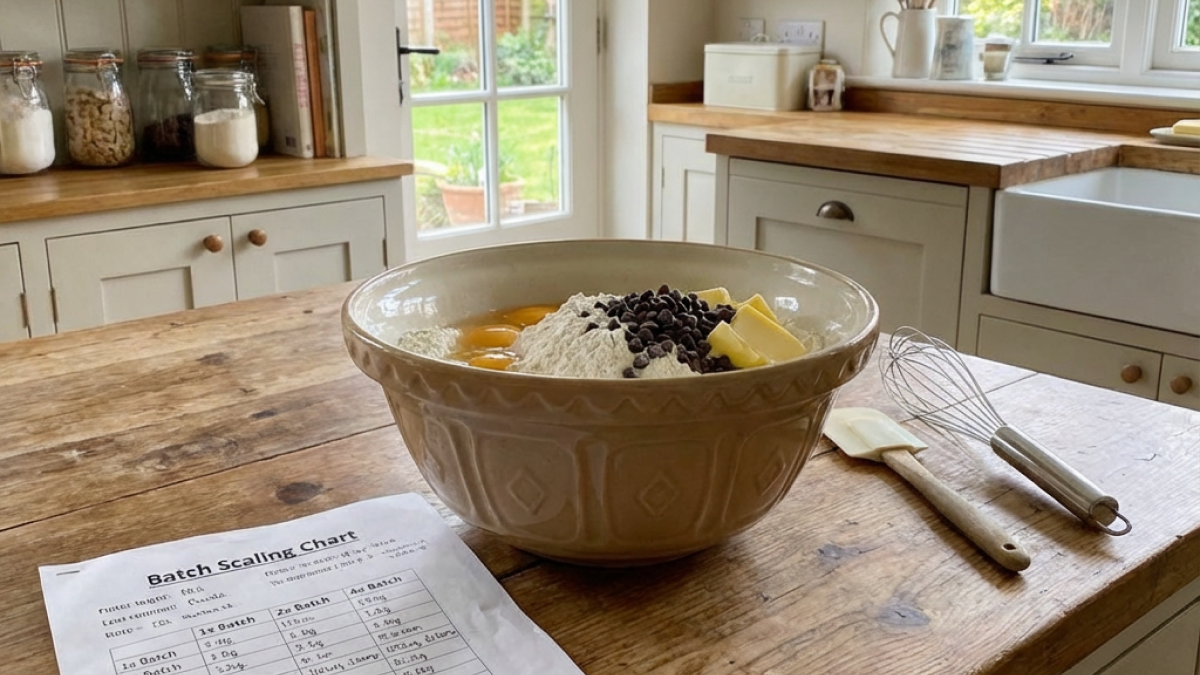
Batch scaling: What does the per-unit cost look like at 24 vs. 48 vs. 96 units? This informs production planning and pricing decisions.
Scenarios: When Costs Change
Scenario 1: Butter Price Increase
Butter goes from $9.00/kg to $11.00/kg (a 22% increase).
Previous butter cost per batch: $2.97 New butter cost per batch: $3.63 Per-croissant increase: $0.03
If you're selling 100 croissants daily, that's $90/month in added costs. Do you absorb it, raise prices, or find a cheaper butter? This is why tracking ingredient costs matters.
Scenario 2: New Hire vs. Experienced Baker
Experienced baker labor time: 106 minutes per batch (4.4 min/unit) New hire labor time: 160 minutes per batch (6.7 min/unit)
Labor cost difference: $18/batch or $0.86/croissant
Training has a real cost. So does the decision to keep producing at full capacity while a new baker learns. Some bakeries reduce croissant production during training periods rather than eat the labor inefficiency.
Scenario 3: Premium Butter for Premium Pricing
Switch from $9/kg butter to $15/kg French AOC butter.
Additional butter cost per croissant: $0.09 Required price increase to maintain margin: ~$0.18
Can you sell a $4.50 croissant at $4.68? Probably not—$4.75 or $5.00 is more realistic. Does the quality improvement justify that jump? You need to test it.
Practical Adjustments
Once you know your costs, you can make informed decisions:
If labor is too high:
- Invest in a dough sheeter (reduces lamination time by 40-50%)
- Batch larger quantities less frequently
- Use overnight retard to shift labor between days
- Pre-shape and freeze (though this affects quality)
If ingredient costs are too high:
- Negotiate volume pricing with butter supplier
- Test slightly lower butter ratios (24-26%)
- Reduce waste through better technique and training
If yield is too low:
- Track yield by baker to identify training needs
- Invest in consistent proofing (proof box vs. ambient)
- Review your shaping technique for waste reduction
The Croissant Profitability Question
Some bakeries lose money on croissants and don't know it. Others make croissants their most profitable item through volume and efficiency.
The difference usually comes down to:
Volume: A bakery making 200+ croissants daily has radically different economics than one making 24. Same product, different business.
Equipment: A sheeter, proof box, and deck oven improve consistency and reduce labor. That capital investment pays back through lower per-unit costs.
Expertise: An experienced laminator works faster and wastes less. That expertise has real dollar value.
Pricing confidence: Knowing your exact costs lets you price without fear. A $4.50 croissant isn't "expensive"—it's what the product costs plus reasonable margin.
Your Next Steps
- Weigh your actual recipe: Don't trust memory. Weigh every ingredient next time you make croissants.
- Time your actual labor: Including setup and cleanup. Be honest about interruptions.
- Track your actual yield: For a week, count inputs vs. sellable outputs.
- Build your cost model: Whether in a food cost calculator or spreadsheet, put real numbers in.
- Compare to your price: Are you making the margin you thought? More? Less?
The numbers might surprise you. Better to be surprised now than wonder in six months why your profitable bakery is struggling to make payroll.
Need a croissant lamination calculator that handles sub-recipes, yield tracking, and automatic price updates? Visit dicedos.com to see how our platform helps bakeries master viennoiserie costing.