
How to Set Wholesale Pricing for Cafes and Restaurants
Published: November 15, 2025
The first wholesale inquiry is exciting. A local cafe wants to carry your croissants. A restaurant asks about supplying their bread program. It feels like validation.
Then reality sets in: what do you charge?
Price too high and you lose the account. Price too low and you're working harder for less money than your retail business. Most bakeries get this wrong at least once before figuring out a system that actually works.
Wholesale Isn't Just Retail with a Discount
This is the mistake everyone makes. You sell croissants for $4.50 retail, so you offer them to cafes at $3.00 and call it wholesale pricing.
That math doesn't work.
At $4.50 retail, you're making maybe $1.50 in profit after costs. At $3.00 wholesale, you've cut your margin by two-thirds—but you haven't cut your costs by anywhere near that much. The ingredients are the same. The labor is the same. Your ovens still run at the same temperature.
Wholesale pricing needs its own cost basis, not a retail discount.
Start with Your True Costs
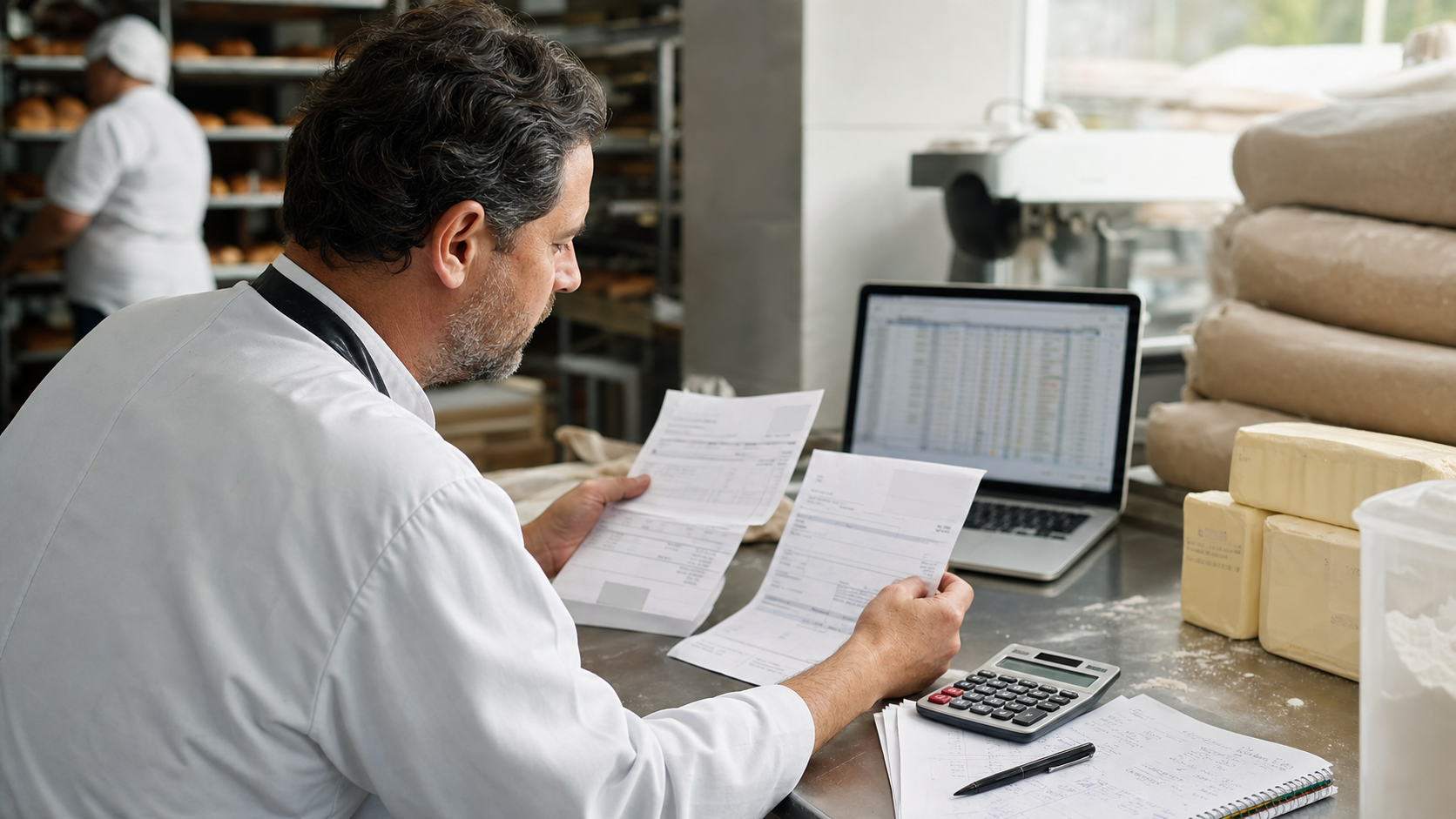
Before setting any wholesale prices, you need accurate recipe costing. Not estimates. Not "about $1.50 in ingredients." Actual numbers from actual invoices.
For each product you're considering for wholesale, calculate:
Ingredient cost per unit Using current supplier prices, not what you paid six months ago. A good food costing app tracks this automatically. A bakery recipe costing software updates costs when invoices change.
Labor cost per unit How many minutes of work goes into each item? Multiply by your loaded labor rate (wages plus taxes, benefits, and workers' comp—usually 25-35% above base wage).
Packaging cost Wholesale packaging is usually simpler than retail. A kraft box versus branded packaging. Bulk trays versus individual bags. Factor in what the wholesale order actually requires.
Delivery cost allocation This is where most bakeries lose money. More on this below.
Overhead contribution Rent, utilities, equipment, insurance—these don't go away because you're selling wholesale. Each product should carry some overhead burden.
Add it all up. That's your floor. You cannot sell below that number and stay in business.
The Wholesale Margin Question
What margin should you target on wholesale accounts?
Industry standard for bakery wholesale is 15-25% net margin. That's lower than retail (which typically runs 25-40%), but the volume and predictability compensate.
Here's how the math works for a croissant:
| Cost Component | Amount |
|---|---|
| Ingredients | $0.85 |
| Labor | $1.20 |
| Packaging (bulk) | $0.10 |
| Delivery allocation | $0.25 |
| Overhead | $0.30 |
| Total cost | $2.70 |
At 20% margin, your wholesale price is $3.38 ($2.70 ÷ 0.80).
At 25% margin, your wholesale price is $3.60 ($2.70 ÷ 0.75).
Round to practical numbers—$3.35 or $3.50—and you have your starting point.
Volume Tiers: When to Discount
Volume discounts make sense when larger orders actually reduce your costs. Not as a sales tactic. Not because the customer asked nicely.
Real cost reductions from volume:
Production efficiency: Making 200 croissants is more efficient per unit than making 50. Setup time, oven utilization, and packaging flow all improve.
Delivery efficiency: One drop of 200 units costs almost the same as one drop of 50 units. Your delivery cost per unit drops dramatically.
Ingredient pricing: Larger production volumes might unlock better supplier pricing or reduce waste from partial bags.
A typical tier structure:
| Weekly Volume | Price | Discount |
|---|---|---|
| 1-49 units | $3.50 | Base |
| 50-99 units | $3.35 | 4% |
| 100-199 units | $3.20 | 9% |
| 200+ units | $3.00 | 14% |
The discounts should roughly match your actual cost savings. If jumping from 50 to 100 units saves you $0.12 per unit in efficiency, a $0.15 discount still protects your margin.
Don't offer volume tiers you can't actually produce efficiently. If 200 croissants maxes out your oven capacity and requires overtime labor, that "volume" isn't actually cheaper to produce.
The Delivery Trap
This is where I've seen bakeries bleed money for years without realizing it.
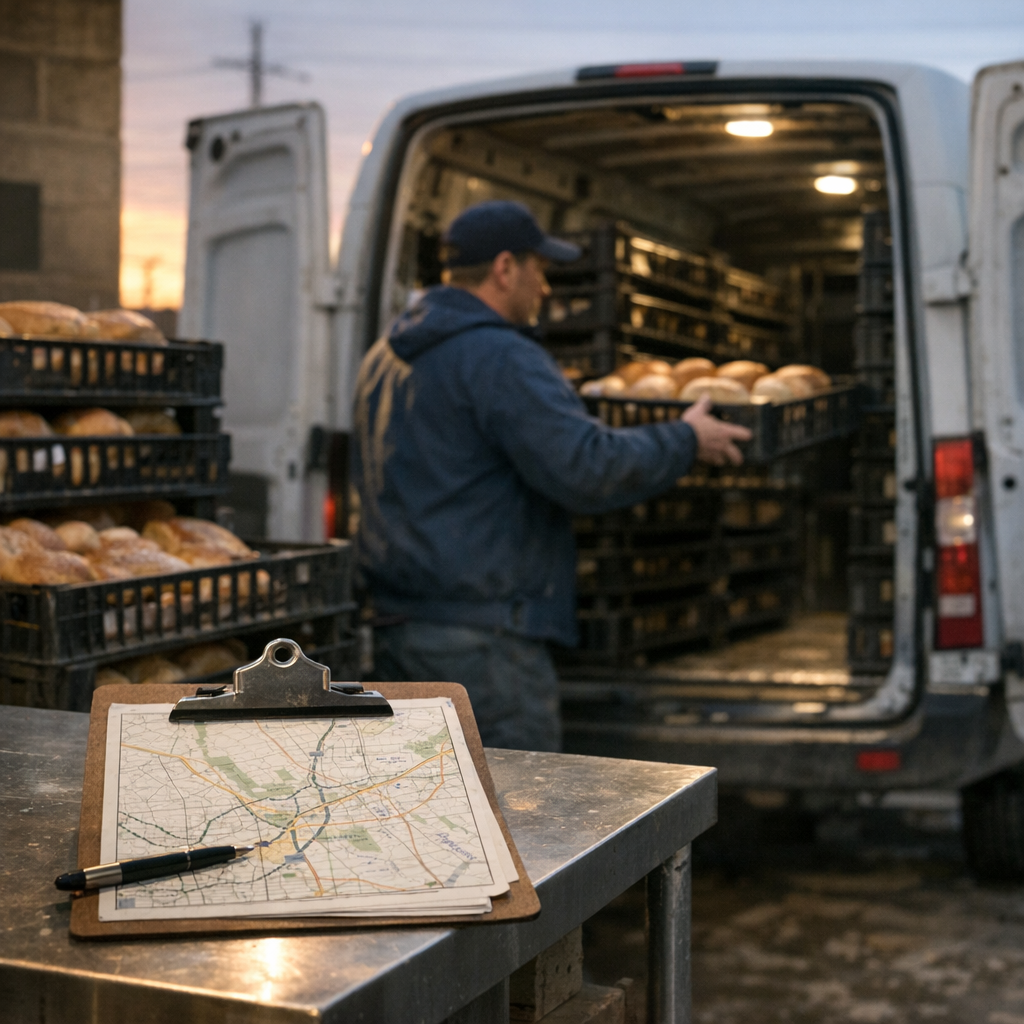
A cafe orders $150 worth of product weekly. You deliver it because "that's what wholesale means." Your delivery takes 45 minutes round trip, plus loading time. Your driver costs $25/hour loaded.
That delivery costs you $20-25. On a $150 order with 20% margin, you're making $30 gross—and spending $20-25 to deliver it.
Your actual margin on that account: 3-7%.
Options for Handling Delivery
Build delivery into pricing: Calculate your delivery cost per account and add it to every unit. If delivery costs $20 and they order 50 units, that's $0.40 per unit added to your wholesale price.
Set minimum orders: Require orders that justify delivery costs. If delivery costs $20 and you need 15% margin on delivery alone, your minimum order is ~$135.
Charge delivery fees: Flat delivery fee ($15-25) or distance-based pricing. Be transparent about it.
Offer pickup pricing: Some accounts will pick up if the price is right. Your $3.50 wholesale price becomes $3.20 for pickup orders.
Route optimization: Cluster deliveries geographically. If you can hit four accounts in one 90-minute route, your delivery cost per account drops to $8-10.
The worst approach: eating delivery costs to "build the relationship" and hoping it works out later. It won't. You'll resent the account, service will suffer, and you'll eventually lose them anyway—after years of subsidizing their business.
Pricing for Different Account Types
Not all wholesale accounts deserve the same pricing structure.
Cafes (Resale)
They're buying your product to resell at a markup. They need room to make their own margin—typically 50-100% above their cost.
If you charge $3.50 and they sell at $5.50, they're making $2.00 per croissant. That's a decent margin for them, and your pricing works.
If you charge $4.00 and they need to sell at $6.50 to maintain margin, your croissant might price itself out of their market.
Consider: what can their customers afford? Work backward from that.
Restaurants (Menu Component)
Restaurants use your bread as part of a larger dish. The bread basket, the burger bun, the sandwich loaf. They're less price-sensitive per unit because your product is a small part of their plate cost.
But they're extremely demanding about consistency. They need the same size roll every time, delivered on schedule, with zero quality variance.
Price for reliability. If you can guarantee consistency, you can charge a premium over commodity suppliers.
Hotels and Catering
Large volumes, thin margins, payment terms that stretch 30-60 days. Proceed carefully.
The volume looks attractive. But if you're producing 500 croissants weekly for a hotel at 12% margin with net-45 payment terms, you're essentially financing their business while making almost nothing.
Require deposits. Negotiate shorter payment terms. Or politely decline.
Contract Terms That Protect Your Margins
Handshake deals are fine until butter prices jump 40% in six months. Then you're locked into pricing that loses money on every unit.
Smart wholesale contracts include:
Price adjustment clauses: "Prices subject to change with 30 days notice" at minimum. Better: automatic adjustment tied to ingredient cost changes above a threshold (5-10%).
Minimum order requirements: Written, not assumed. Include what happens if they fall below minimums—price increases, delivery fees, or order consolidation requirements.
Payment terms: Net-15 is standard for small wholesale accounts. Larger accounts might negotiate net-30. Beyond that, you're becoming a bank.
Exclusivity limitations: Be careful about agreeing to be someone's "exclusive croissant supplier" unless the volume justifies it. You're giving up market opportunity.
Cancellation terms: What happens if they cancel an order after you've already baked it? Most bakeries require 48-72 hour notice for order changes.
Using Recipe Costing for Wholesale Decisions
Good bakery recipe costing software becomes essential at scale. When you have 15 wholesale accounts and 30 products, tracking costs manually is impossible.
What recipe costing tools should do for wholesale:
Per-account profitability: Which accounts actually make you money? Which are break-even or worse?
Product-level margins by channel: Your retail croissant at $4.50 makes 35% margin. Your wholesale croissant at $3.50 makes 18% margin. Both are fine—but you need to know the difference.
Scenario planning: If butter increases $0.50/lb, how does that affect each account's profitability? Which accounts need price adjustments first?
Break-even analysis: What volume do you need from a new account to cover the production changeover and delivery costs?
A food costing app that handles wholesale complexity saves hours weekly and prevents costly mispricing.
When to Say No
Not every wholesale inquiry deserves a yes.
Red flags to watch for:
They're shopping on price alone: If they're comparing you to Sysco bread, you're not the right supplier for them. And they're not the right customer for you.
Their volume doesn't justify delivery: A cafe ordering $75/week and expecting free delivery is asking you to subsidize their business.
They want to "try you out" with artificially low pricing: Trial periods are fine. Trial pricing isn't. Your costs don't decrease because it's a trial.
Payment history concerns: Ask for references. Check them. A cafe that pays their current bread supplier 60 days late will pay you 60 days late.
Location creates delivery inefficiency: A single account 45 minutes from your other drops costs more to service than it will ever return in margin.
Saying no to bad accounts frees capacity for good ones. And there are always good ones looking for a reliable bakery partner.
Real Example: Building a Wholesale Pricing Sheet
Here's what an actual wholesale pricing sheet might look like:
Standard Pricing (Pickup or Route Delivery)
| Product | 1-49 | 50-99 | 100+ |
|---|---|---|---|
| Croissant | $3.50 | $3.35 | $3.20 |
| Pain au Chocolat | $3.75 | $3.60 | $3.45 |
| Almond Croissant | $4.25 | $4.10 | $3.95 |
| Sourdough Loaf | $5.50 | $5.25 | $5.00 |
| Baguette | $3.00 | $2.85 | $2.70 |
| Brioche Bun (6-pack) | $8.00 | $7.60 | $7.20 |
Terms
- Minimum order: $100 for delivery, no minimum for pickup
- Pickup discount: 5% off listed prices
- Delivery zone A (within 10 miles): Included in minimum order
- Delivery zone B (10-20 miles): $15 fee or $200 minimum
- Payment: Net-15, 2% discount for payment at delivery
- Price adjustments: 30 days notice for changes over 5%
- Order changes: 48 hours notice required
This gives accounts clear expectations and protects your margins.
Building the Relationship
Wholesale is relationship business. Your cafe accounts see you (or your driver) multiple times weekly. They depend on you for a product their customers expect.
That relationship is worth something—but it doesn't mean giving away margin.
What builds good wholesale relationships:
Consistency: Same quality, same time, every delivery. This matters more than price.
Communication: If you're out of almond croissants, call before delivery, not during.
Flexibility on specifics: Can you adjust delivery time by 30 minutes? Can you do a half-pan of muffins instead of full? Small accommodations build loyalty.
Firmness on fundamentals: Pricing, payment terms, and minimums aren't negotiable just because they ask nicely. Being reliable includes being financially stable.
The Path Forward
Wholesale can transform a bakery business—reliable volume, predictable production schedules, reduced retail labor. But only if the pricing works.
Start with accurate costs. Build your pricing from there. Set clear terms. Track profitability by account. Adjust when ingredients change.
And don't be afraid to charge what you're worth. A great croissant is a great croissant, whether it's sold retail at $4.50 or wholesale at $3.50. Your accounts know quality. They'll pay for it if you value it yourself.
Managing wholesale pricing across multiple accounts? Visit dicedos.com to see how our recipe costing tools help bakeries track margins, adjust for ingredient changes, and identify their most profitable accounts.