When to Raise Prices: A Baker's Guide to Price Adjustments
Published: November 3, 2025
Nobody enjoys raising prices. It feels like you're asking customers to pay more for the same thing—and you worry they'll say no by walking out the door.
But here's the alternative: watch your margins shrink month after month until you're working harder than ever for less money, eventually facing the choice between major cuts or closing altogether.
Price increases aren't a failure. They're a normal part of running a sustainable business. The question isn't whether to raise prices, but when, how much, and how to do it without damaging customer relationships.
The Signals That It's Time
Not every cost increase requires a price increase. But some situations clearly call for one.
Your Margin Trigger
Set a threshold. When margins drop below that threshold, it's action time.
Example: You target 30% food cost. When food cost hits 33-34%, you investigate. If it's not a short-term spike or operational issue, prices need adjustment.
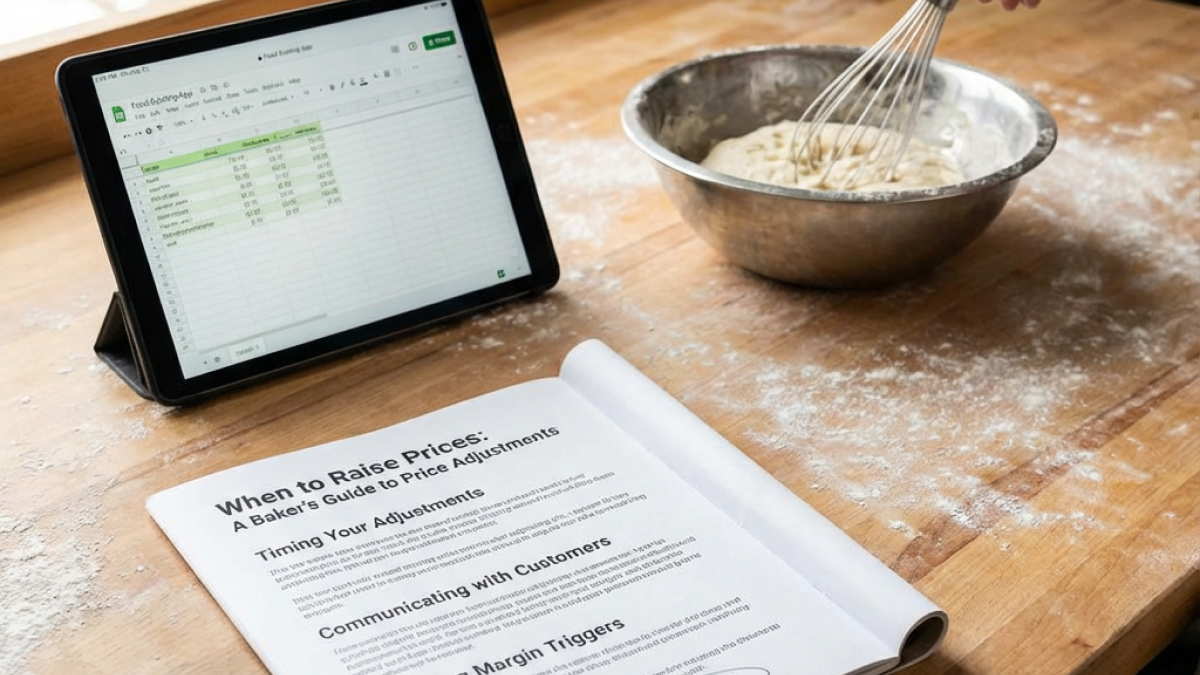
A food costing app makes this visible automatically. Without one, you need to calculate food cost percentage manually at least monthly.
Major Ingredient Price Increases
Small fluctuations are normal. Absorb them if you can. But major moves—butter up 25%, flour up 15%—require response.
Rule of thumb: ingredient increases over 10% on high-impact items warrant pricing review.
Cumulative Creep
No single ingredient jumped dramatically, but everything crept up 3-5% over the past year. Death by a thousand cuts.
If you haven't raised prices in 18 months and your food cost percentage has drifted up 4-5 points, cumulative creep has eroded your margin.
Labor Cost Increases
Minimum wage increase? New benefits requirement? Labor cost jump from hiring more experienced staff?
Labor costs don't affect food cost percentage, but they affect your total cost. Pricing must cover total cost, not just ingredients.
Operating Cost Increases
Rent increase. Insurance increase. New equipment financing. Utility rate jump.
These fixed costs get allocated across everything you sell. Higher fixed costs require higher revenue to maintain margin.
Competitive Price Movement
If competitors raised prices and you didn't, you might have room to catch up without losing business.
Monitor what other bakeries in your market charge. Not to copy—to understand positioning.
How Much to Increase
Deciding to raise prices is step one. Deciding by how much is step two.
The Cost-Recovery Approach
Calculate exactly how much your costs increased and price accordingly.
If croissant cost went from $1.80 to $2.00 (11% increase) and you were selling at $3.50 with 49% margin, you need to increase to about $3.85-3.90 to maintain margin.
This is the most defensible approach—you're passing through actual cost increases.
The Round-Number Approach
Customers prefer round prices. $3.75 feels different than $3.73.
If cost-recovery says $3.73, round to $3.75 or even $4.00 depending on psychology and competitive positioning.
The Catch-Up Approach
Haven't raised prices in two years? You probably need more than a cost-recovery increase.
Add historical cumulative increases plus current increases plus a buffer for the next year.
If you're 15% behind where you should be, a 15% increase in one shot might shock customers. Consider 8-10% now and another 5-7% in six months.
The Margin-Target Approach
Back into pricing from your target margin:
Target food cost: 28% Croissant cost: $2.00 Required price: $2.00 / 0.28 = $7.14
Then adjust for market reality—$7.14 might be unrealistic, requiring cost reduction instead of (or alongside) price increase.
Testing Price Sensitivity
Not sure how much customers will tolerate? Test.
Raise prices on 3-4 items. Watch volume for 2-3 weeks. Did sales drop significantly? Hold steady on other items and reassess.
If volume held, proceed with broader increase. If volume dropped, recalibrate.
How to Communicate
The communication matters as much as the increase itself.
The Low-Key Approach
Many bakeries simply update prices without announcement. New prices appear on the menu board, receipts reflect the change, most customers don't notice or comment.
This works well for:
- Small increases (under 5%)
- Items with less price sensitivity
- Retail environments with casual transactions
The Direct Explanation
For significant increases or loyal customers, explain briefly:
"You may notice our croissant price went up to $4.00. Butter prices have increased 20% this year, and we need to adjust to maintain the quality you expect from us."
Keep it factual, not apologetic. You're not asking permission—you're explaining a business decision.
The Advance Notice
For wholesale accounts or regulars who rely on consistent pricing:
"Starting April 1st, we're implementing a price adjustment across our menu. Our new prices will be [X]. Please reach out with any questions."
Give 2-4 weeks notice. Allow them to plan.
What NOT to Do
Don't over-explain or apologize excessively. "We're SO sorry, we really didn't want to do this, we feel terrible..." makes you seem desperate and invites negotiation.
Don't blame. "Our greedy suppliers..." might be true, but it sounds like excuses.
Don't promise to reverse. "We'll lower prices when things improve" ties your hands.
Don't hide. Stealth increases on regular wholesale accounts damage trust. Be upfront.
Implementing the Increase
Logistics matter. Do this well.
Pick Your Timing
Good timing:
- Start of a month/quarter (clean break)
- After a traditionally slow period (less disruption)
- When you're launching new items (price adjustment bundled with new offerings)
Bad timing:
- Right before a major holiday (peak demand)
- During your busiest week
- When you're already addressing other service issues
Update All Touchpoints
Menu boards: Physical signage Online menus: Website, delivery platforms POS system: Price database Printed materials: Price lists, wholesale sheets Staff knowledge: Everyone should know new prices
Brief Your Team
Your staff will field questions and complaints. Prepare them:
- What changed and why (brief version)
- How to respond to questions
- When to escalate to management
Monitor the Response
For two weeks after changes:
- Track sales volume by item
- Note customer feedback
- Watch for account cancellations (wholesale)
- Calculate new margins
If something isn't working, you can adjust. But don't panic over first-week reactions—let things stabilize.
Handling Pushback
Not everyone will accept increases quietly.
Individual Customer Complaints
"Your croissants are too expensive now."
Response options:
- "I understand. Our costs have increased significantly, and this allows us to maintain quality."
- "Thank you for the feedback. We're confident our quality justifies the price."
- Say nothing and complete the transaction professionally.
Don't argue. Don't defend. Don't offer discounts to complainers—it trains them to complain.
Wholesale Account Negotiation
"We can't pay these new prices."
Options:
- "I understand budgets are tight. Let me know how you'd like to adjust your order mix."
- "The price reflects our current costs. We value your business and hope we can continue."
- "Let's discuss whether there are volume adjustments that would work for both of us."
Some accounts will leave. Some are negotiating and will stay at new prices. Some genuinely can't afford it—and shouldn't be buying premium products.
The Comparison Game
"Your competitor charges less."
Response: "We can't speak to others' pricing. We price based on our quality and costs."
Don't trash competitors. Don't match their prices unless your analysis supports it. If someone wants the cheapest option, you may not be it—and that's okay.
When NOT to Raise Prices
Price increases aren't always the answer.
When Costs Are Temporary
Butter spiked due to a supply disruption but is expected to normalize in two months? Maybe absorb it rather than raising prices you'll want to lower later.
When You're Already Overpriced
If you're at the high end of your market and losing customers, higher prices won't help. Look at costs instead.
When Quality Has Slipped
Raising prices while quality is declining is a recipe for customer exodus. Fix quality first.
When Better Options Exist
Before raising prices, exhaust alternatives:
- Can you reduce portion sizes (careful—this has its own risks)
- Can you simplify recipes to reduce costs?
- Can you negotiate better supplier terms?
- Can you improve efficiency to reduce labor cost?
Sometimes operational improvement is better than price increase.
The Long View
Price increases should be regular, small, and expected—not rare, large, and shocking.
Annual Review Habit
Every year, review your pricing:
- How have costs changed?
- How have margins changed?
- How has competitive landscape changed?
- Is adjustment needed?
Even if the answer is "no increase this year," you've made a conscious decision rather than defaulting to inaction.
Small and Frequent vs. Large and Rare
A 3% increase annually is easier for customers to absorb than a 10% increase every three years—even though the cumulative effect is similar.
Small increases blend into normal price variation. Large increases feel like events and draw attention.
Communicate Value, Not Just Price
Ongoing marketing should emphasize why you're worth your prices:
- Quality ingredients
- Craftsmanship
- Consistency
- Service
- Community connection
When customers understand value, price becomes less of a hurdle.
The Bottom Line
Raising prices is a normal business activity. You're not cheating anyone—you're ensuring your bakery can continue to exist and serve customers.
Watch your margins. Set triggers. When it's time, calculate the right increase. Communicate clearly. Implement cleanly. Monitor results.
Then keep baking.
Want to know exactly when costs require price adjustments? Visit dicedos.com to see how our food costing app tracks ingredient prices, calculates margins, and alerts you when it's time to revisit pricing.