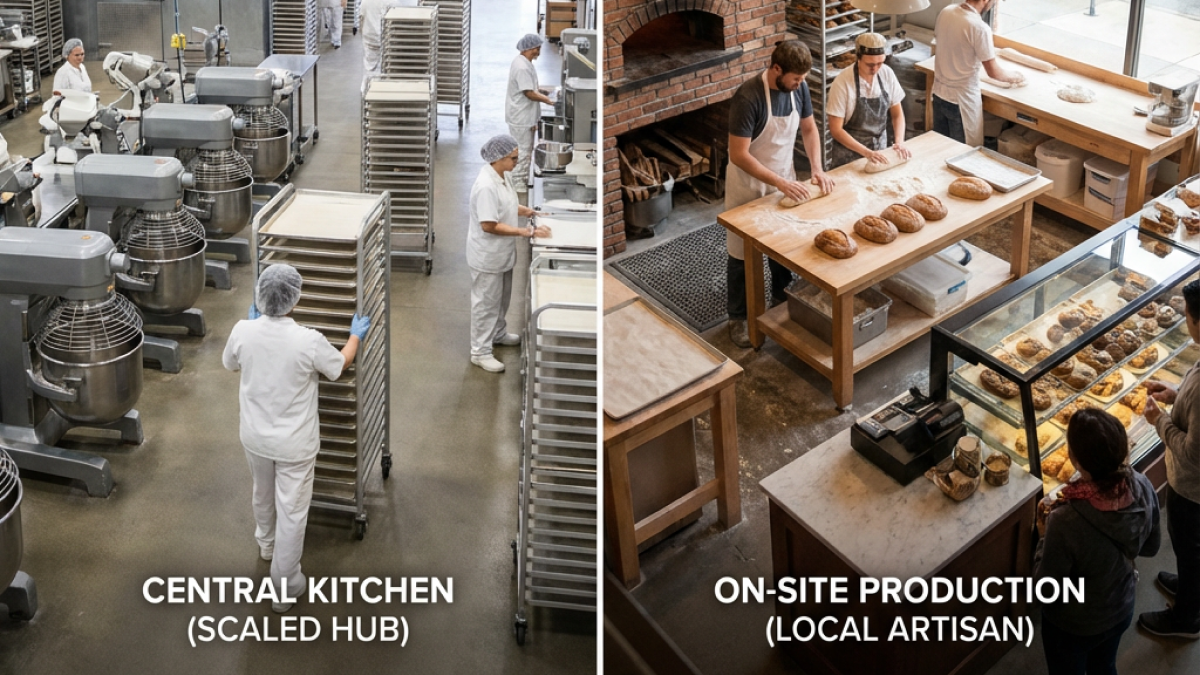
Central Kitchen vs. On-Site Production: Making the Right Choice for Your Bakery
Published: December 15, 2025
The question comes up whenever a wholesale bakery grows beyond a single location: should we build a central production kitchen?
It's seductive logic. Consolidate production in one purpose-built facility. Equip it properly. Staff it with specialists. Deliver finished or partially finished products to retail locations, cafés, and wholesale customers. Professional operations do it this way—shouldn't you?
Maybe. But maybe not.
I've seen central kitchens transform bakery businesses, enabling growth that would have been impossible otherwise. I've also seen them become expensive albatrosses, consuming capital and management attention while failing to deliver promised benefits.
The difference isn't luck. It's understanding when a central production kitchen makes sense and when it doesn't—then executing the right model for your specific situation.
This guide walks through the decision framework for commercial bakery setup, helping you evaluate whether a central bakery operations model fits your business.
Understanding the models
Let's clarify what we're comparing.
On-site production (distributed model)
Each location produces its own products:
- Retail bakery: Full production in each shop
- Wholesale bakery: Single production location serving all customers
- Multi-location: Each location has its own production capability
Characteristics:
- Production equipment at each location
- Bakers at each location
- Limited specialization
- Products travel short distances
Central kitchen (consolidated model)
Production consolidated in a dedicated facility:
- Separate from retail or customer-facing locations
- Products transported to retail locations or customers
- May produce finished goods or components
Characteristics:
- Purpose-built production space
- Specialized equipment
- Dedicated production staff
- Distribution/logistics infrastructure
Hybrid models
Many bakeries operate somewhere in between:
- Central production of some items, on-site finishing
- Base products made centrally, customization on-site
- High-volume items centralized, specialty items distributed
Common hybrid approaches:
- Parbaked bread: Produced centrally, baked to finish on-site
- Laminated dough: Croissant dough made centrally, shaped and baked on-site
- Component production: Fillings, toppings made centrally; assembly on-site
When central production makes sense
A central kitchen isn't automatically better. It makes sense under specific conditions.
Condition 1: Sufficient scale
Central kitchens have high fixed costs. You need enough volume to spread those costs effectively.
Rule of thumb: Central production typically makes sense when you're producing:
- 500+ units daily of consistent products, or
- $500,000+ annual revenue from products suitable for central production
Below these thresholds, the fixed costs typically outweigh the benefits.
Condition 2: Products that travel well
Not everything benefits from centralization:
Good candidates for central production:
- Breads (crusty, sandwich, specialty)
- Laminated dough products (croissants, Danish)
- Cookies and bars
- Components (fillings, bases, toppings)
- Frozen products
Poor candidates for central production:
- Products that must be served immediately from oven
- Highly perishable items with short shelf life
- Items requiring last-minute customization
- Products where "baked fresh" perception is essential
Condition 3: Logistics capability
Centralization only works with reliable logistics:
Requirements:
- Appropriate vehicles (refrigerated if needed)
- Delivery routes that work economically
- Driver availability
- Backup plans for vehicle failures
Geographic considerations:
- Dense delivery area: Central makes more sense
- Spread-out locations: Logistics costs may exceed production savings
Condition 4: Capital and expertise
Central kitchens require significant investment:
Capital needs:
- Facility lease deposits
- Equipment purchases
- Initial inventory
- Working capital during transition
Expertise needs:
- Production management at scale
- Logistics coordination
- Quality control across distance
- Multi-location management
If either capital or expertise is limited, central production carries higher risk.
The economics of centralization
Let's look at the financial case for central production.
Potential cost savings
Equipment efficiency:
- One large mixer vs. multiple small mixers
- Professional-grade equipment that smaller locations can't justify
- Better capacity utilization
Labor efficiency:
- Specialized roles (mixer operators, decorators)
- Longer production runs
- Less setup time between products
- Potentially lower wage rates for production-only facility
Ingredient costs:
- Larger bulk purchases
- Less waste from consolidation
- Better inventory management
Overhead distribution:
- Single facility lease vs. production space at multiple locations
- Consolidated utilities
- Centralized management
Quality benefits with economic impact:
- More consistent products
- Fewer rejections and remakes
- Better customer satisfaction
Costs that increase
Logistics:
- Delivery vehicle acquisition or lease
- Fuel and maintenance
- Driver wages
- Packaging for transport
Facility costs:
- Central facility lease
- Utilities for larger space
- Insurance
- Compliance requirements
Management overhead:
- Coordination complexity
- Quality control across distance
- Communication systems
- Planning and scheduling
Transition costs:
- Equipment moves
- Staff transitions
- Learning curve inefficiency
- Potential disruption to customers
Running the numbers
Example analysis:
Current state (distributed):
- 3 retail locations each with production
- Combined production labor: $180,000/year
- Combined equipment depreciation: $30,000/year
- Production space at each location: $60,000/year (portion of rent)
- Ingredient costs: $200,000/year
- Total: $470,000/year
Central kitchen model:
- Central facility rent: $48,000/year
- Central production labor: $150,000/year (efficiency gains)
- Central equipment (new, more efficient): $40,000/year
- Ingredient costs: $190,000/year (bulk pricing)
- Delivery costs (new): $45,000/year
- Total: $473,000/year
In this example, the numbers are nearly identical—central production doesn't automatically save money. The benefits would need to come from quality improvements, growth enablement, or other factors.
The strategic case for centralization
Sometimes central production makes sense even without clear cost savings.
Enabling growth
Production bottleneck removal: If your current facilities can't produce more volume, a central kitchen removes that constraint.
New market access: Central production might enable wholesale bakery accounts or geographic expansion that wouldn't otherwise be possible.
Product line expansion: A purpose-built facility might support products you can't currently make.
Quality and consistency
Standardization: Central production can improve consistency across locations—every croissant made the same way.
Specialization: Dedicated production staff can develop expertise that's hard to maintain at distributed locations.
Equipment quality: A central facility can justify equipment that improves product quality.
Operational simplification
Management focus: Separating production from retail/service lets managers focus on their core function.
Training simplification: New retail staff don't need production training; new production staff don't need retail training.
Scheduling: Production schedules can be optimized independently of retail hours.
The case against centralization
Central production isn't right for everyone.
Loss of flexibility
Responsiveness: On-site production can respond to unexpected demand; central production requires forecasting.
Customization: Last-minute special requests become logistics challenges.
Menu changes: Testing new products is more complex when production is separate.
Quality risks
Freshness perception: "Baked fresh in our kitchen" is a powerful differentiator that centralization eliminates.
Product degradation: Some products suffer from transportation and time.
Consistency paradox: Centralization can improve consistency, but logistics failures can create inconsistency.
Complexity costs
Coordination overhead: Managing production and distribution requires more planning and communication.
Multiple points of failure: Vehicle breakdowns, delivery errors, and miscommunication create problems that don't exist with on-site production.
Management bandwidth: Running a central facility plus distribution is essentially running an additional business.
Capital and risk
Upfront investment: Central kitchens require significant capital before benefits materialize.
Lease commitments: Long-term leases add fixed costs and reduce flexibility.
Technology dependence: Proper forecasting, ordering, and logistics require systems.
Decision framework
Here's a structured approach to the decision.
Step 1: Assess your situation honestly
Current pain points:
- Are you running out of production capacity?
- Is quality inconsistent across locations?
- Are your production costs clearly higher than they should be?
- Is management time consumed by production issues?
Growth trajectory:
- How much are you growing annually?
- Where is growth coming from (locations, wholesale, volume)?
- Is growth constrained by production capacity?
Financial position:
- Do you have capital for investment?
- Can you absorb transition costs and temporary inefficiency?
- What's your risk tolerance?
Step 2: Model the alternatives
Status quo: What happens if you don't change? What are the costs of not centralizing?
Full centralization: Complete shift to central production. What are the full costs and benefits?
Hybrid approaches: What would partial centralization look like? Which products centralize; which stay distributed?
Expanded distributed: Instead of centralizing, what if you upgraded your distributed production?
Step 3: Evaluate total impact
Financial:
- Capital requirements
- Operating cost changes
- Revenue implications
Operational:
- Complexity changes
- Quality implications
- Flexibility impact
Strategic:
- Growth enablement
- Competitive positioning
- Risk exposure
Step 4: Consider the transition
Even if centralization makes sense, the transition matters:
Transition risks:
- Customer disruption
- Staff uncertainty
- Quality issues during changeover
- Unexpected costs
Transition timeline:
- Realistic implementation schedule
- Phased vs. all-at-once approach
- Contingency plans
Step 5: Make the call
There's no formula that spits out the answer. After thorough analysis, you make a judgment call:
- Does the long-term benefit justify the short-term cost and risk?
- Do you have the management capacity to execute this change?
- Is this the right use of your limited capital and attention?
Implementing central production
If you decide to centralize, execution determines success.
Facility selection
Location factors:
- Accessibility to delivery routes
- Labor market (can you hire here?)
- Landlord flexibility
- Room for growth
Facility requirements:
- Food-safe construction
- Appropriate utilities (electrical, gas, water)
- Loading dock access
- Storage space
- Compliance with local regulations
Lease terms:
- Length (long enough to amortize investment, not so long you're locked in)
- Expansion options
- Exit clauses
- Build-out responsibilities
Equipment planning
Production equipment:
- Right-sized for projected volume (not just current)
- Quality level appropriate for central role
- Redundancy for critical equipment
- Compatibility with your products and processes
Storage equipment:
- Ingredient storage (dry, refrigerated, frozen)
- Finished goods staging
- Component storage
Logistics equipment:
- Delivery vehicles
- Packaging systems
- Loading equipment
Staffing the central kitchen
Key roles:
- Production manager (critical hire)
- Lead bakers by shift
- Specialty positions (decorators, lamination specialists)
- Logistics/delivery staff
Staffing considerations:
- Some existing staff may transfer
- Production-only environment is different from retail bakery
- Management skills become more important at scale
- Night/early shifts may be required
Process development
Documentation:
- Standardized recipes at central kitchen scale
- Production schedules and sequences
- Quality control checkpoints
- Delivery procedures
Systems:
- Order management (from locations to central)
- Production scheduling
- Inventory management
- Delivery routing and tracking
Quality control at distance
Challenges:
- You're not there to taste every batch
- Problems aren't discovered until delivery
- Feedback loop is longer
Solutions:
- Robust quality checkpoints
- Clear specifications with visual standards
- Regular calibration and auditing
- Fast feedback channels from receiving locations
Managing the transition
Phased approach:
- Start with products most suited to centralization
- Prove the model before expanding
- Maintain on-site backup during transition
- Gradually shift production
Communication:
- Staff need to understand the plan and their role
- Customers may need reassurance about quality
- Suppliers should adjust for consolidated ordering
Contingency planning:
- What if the central kitchen has problems?
- How do you handle delivery failures?
- Who makes the call to revert to distributed production?
Hybrid approaches worth considering
Full centralization isn't the only option.
Component production
Concept: Central kitchen produces components; locations do final assembly.
Examples:
- Croissant dough made centrally; shaped and baked on-site
- Fillings and toppings made centrally; products assembled on-site
- Bread doughs made centrally; baked at locations
Benefits:
- Maintains "baked fresh" for finished products
- Captures efficiency on time-consuming prep
- Simpler logistics (components are more stable)
Parbake model
Concept: Products partially baked centrally, finished on-site.
Examples:
- Bread parbaked 80%; final bake on-site
- Pastries baked but not glazed/finished
- Products frozen mid-process
Benefits:
- Fresh-from-oven for customers
- Quality control on most of process
- Locations need minimal production skill
Volume-based split
Concept: High-volume items centralized; specialty items distributed.
Examples:
- Standard croissants from central; specialty pastries made at locations
- Sandwich bread from central; artisan loaves on-site
- Wholesale orders from central; retail items on-site
Benefits:
- Efficiency on volume products
- Flexibility for specialty items
- Manageable logistics complexity
Tools that support bakery production scaling
Centralization requires better systems.
Production planning
Needs:
- Forecasting across locations
- Production scheduling
- Capacity planning
- Lead time management
Inventory management
Needs:
- Central inventory tracking
- Par levels and reordering
- Multi-location visibility
- Cost tracking
Logistics coordination
Needs:
- Order consolidation from locations
- Route optimization
- Delivery scheduling
- Proof of delivery
Quality management
Needs:
- Standard specifications
- Inspection documentation
- Issue tracking
- Feedback loops
Tools like Diced OS can help manage recipes, costs, and production across multiple locations, providing the visibility and control that central bakery operations require.
The bottom line
Central production can transform a bakery business, but it's not universally right. The decision depends on:
- Your scale and trajectory
- Your products and their travel characteristics
- Your logistics capability
- Your capital and expertise
- Your strategic priorities
Done right, centralization enables growth, improves quality, and creates operational focus. Done wrong, it consumes capital, adds complexity, and distracts management from more important priorities.
Take the time to analyze thoroughly. Model the economics honestly. Consider the risks realistically. Then make the decision that serves your specific bakery's future.
Whether you centralize or stay distributed, what matters is making the choice deliberately—and then executing it excellently.