
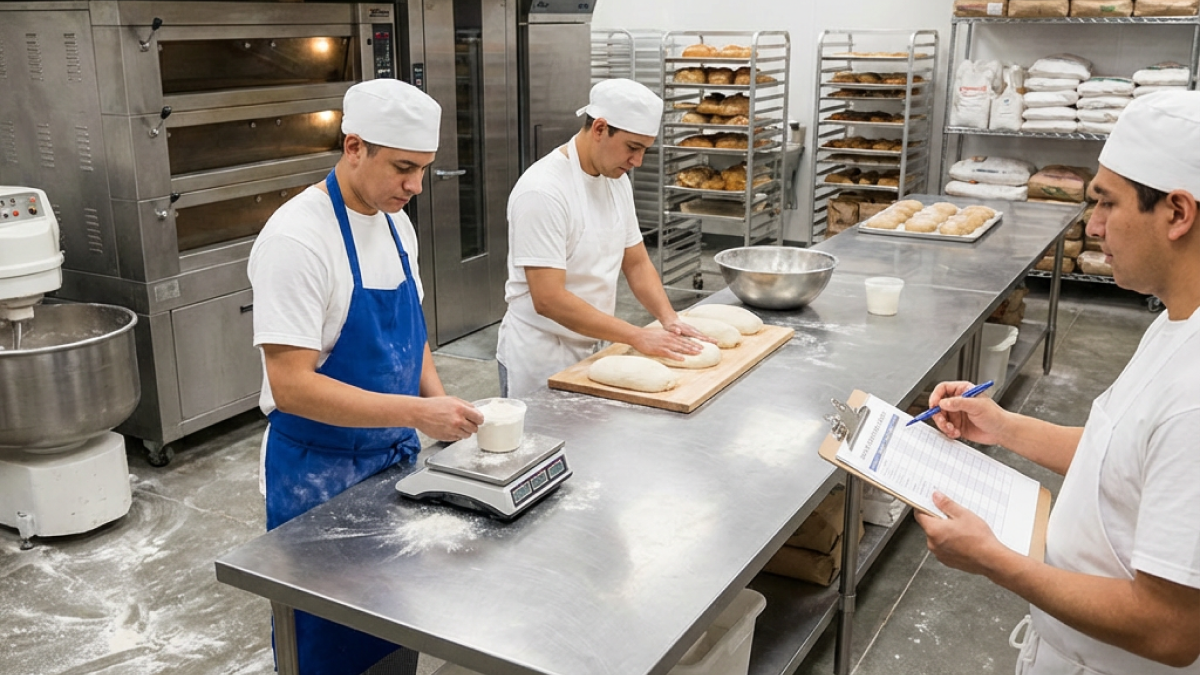
Staff Training for Recipe Consistency: A Practical Guide for Wholesale Bakeries
Published: December 1, 2025
Your recipes are only as good as the hands that make them. You can have the most meticulously developed formulas in your wholesale bakery, but if your team can't execute them consistently, you're building your business on sand.
I've seen it happen too many times: a talented head baker develops incredible products, builds a solid wholesale customer base, then watches it all unravel when they try to scale. The croissants that won those cafe accounts suddenly vary from batch to batch. The sourdough that restaurants loved becomes unpredictable. Customers start complaining, then they stop ordering altogether.
Recipe consistency in commercial bakery operations isn't just about quality—it's about survival. Your wholesale customers depend on receiving the exact same product every single time. A cafe that serves your croissants with their morning coffee can't explain to their customers why Tuesday's croissant was flaky and buttery while Wednesday's was dense and pale.
This guide covers practical training methods that transform new hires into reliable bakers who produce consistent results, whether you're running a small artisan operation or a large-scale commercial bakery.
The real cost of inconsistency in wholesale bakery operations
Before diving into training methods, let's quantify what inconsistency actually costs your bakery business.
Direct financial impact
Consider a wholesale bakery producing 500 croissants daily for various accounts:
- Rejection rate from inconsistency: Even a 5% rejection rate means 25 croissants daily that either get sold at a loss, donated, or thrown away
- At $2.50 wholesale price: That's $62.50 per day, or roughly $1,875 per month in lost revenue
- Annual impact: Over $22,000 in direct losses from a single product line
But the real costs go deeper:
- Customer acquisition costs: Replacing a lost wholesale account typically costs 5-7x more than retaining an existing one
- Rush orders and remakes: When batches fail, you're paying overtime or expedited ingredient deliveries
- Staff turnover: Frustrated bakers who can't achieve consistent results often leave, taking their training investment with them
The ripple effect on bakery management
Inconsistency creates management chaos:
- You can't accurately forecast ingredient needs when yields are unpredictable
- Scheduling becomes guesswork when you don't know how many batches will need to be remade
- Your reputation suffers, making it harder to win new accounts
- Stress levels rise, affecting team morale and further impacting quality
Why traditional training fails in commercial bakeries
Most bakery staff training follows a predictable pattern: the new hire shadows an experienced baker for a few days, gets handed a recipe card, and is expected to figure it out. This approach fails for several reasons.
The "watch and learn" problem
Skilled bakers often don't realize what they're doing. They've internalized techniques to the point where crucial steps happen automatically. When a master baker "feels" that the dough is ready, they might not think to mention the specific visual cues, resistance levels, or timing that led to that conclusion.
A new hire watching this process sees magic, not method. They try to replicate what they saw, miss critical details, and produce inconsistent results.
Recipe cards aren't enough
Written recipes, no matter how detailed, can't capture everything. They might say "mix until smooth" but not explain what smooth actually looks like for that specific dough. They might specify "proof until doubled" without showing what doubled looks like in your specific proofing environment.
Commercial bakery standards require more than written instructions—they require demonstrated understanding.
The curse of knowledge
Experienced bakers forget what it's like to not know. They skip explanations of fundamentals because those concepts seem obvious. But for someone new to professional baking, nothing is obvious.
This knowledge gap leads to:
- Misunderstanding of basic techniques
- Fear of asking "stupid" questions
- Guessing instead of learning
- Developing bad habits that are hard to break
Building a systematic approach to bakery employee training
Effective wholesale bakery training requires structure. Here's a framework that works across different bakery sizes and product types.
Phase 1: Foundation training (Days 1-5)
Before touching any production recipes, new bakers need foundational knowledge.
Day 1-2: Environment and equipment orientation
- Complete tour of the facility with emphasis on workflow
- Introduction to all equipment, including safety protocols
- Explanation of cleaning and sanitation standards
- Overview of ingredient storage and handling
Day 3-4: Core technique workshops
Focus on fundamental techniques that apply across products:
- Proper scaling and measuring (weight-based, not volume)
- Mixer operation and dough development stages
- Understanding fermentation indicators
- Shaping fundamentals
- Oven loading and rotation patterns
Day 5: Assessment and gap identification
Before moving to production training, assess where each trainee needs extra support. This isn't a pass/fail test—it's a diagnostic tool.
Phase 2: Product-specific training (Weeks 2-4)
Now trainees learn your actual recipes, one category at a time.
Week 2: Simplest products first
Start with products that have the highest margin for error. For most bakeries, this means:
- Quick breads and muffins
- Cookies
- Simple yeast breads
Success with simpler products builds confidence before tackling challenging items.
Week 3: Intermediate products
Move to products requiring more technique:
- Enriched doughs
- Basic laminated products
- Products with precise timing requirements
Week 4: Advanced products
Finish with your most demanding recipes:
- Croissants and Danish
- Sourdough products
- Multi-day preparations
Phase 3: Independent production with oversight (Weeks 5-8)
Trainees now work independently but with structured check-ins:
- Daily quality reviews with documented feedback
- Weekly one-on-ones to address questions and concerns
- Gradual reduction of oversight as consistency improves
Creating recipe documentation that actually works
Your recipe documentation is the backbone of consistency. Here's how to create documentation that supports rather than hinders training.
The anatomy of an effective production recipe
Every production recipe should include:
1. Yield and portion specifications
- Exact batch size with weight
- Number of units expected
- Weight per unit (with acceptable range)
2. Ingredient list with specifications
- Weight in grams (not cups or tablespoons)
- Specific product names or codes
- Temperature requirements where relevant
3. Step-by-step process with visual benchmarks
- Clear action descriptions
- Time ranges for each step
- Visual descriptions of what "done" looks like
- Photos or videos of key stages
4. Critical control points
- Temperature requirements
- Timing windows
- Quality checkpoints
- Common problems and corrections
5. Troubleshooting section
- What went wrong and why
- How to identify the problem
- How to prevent it next time
Visual standards documentation
Words aren't enough. Create visual references for:
- Proper dough consistency at each stage
- Correct shaping techniques
- Ideal proofing levels
- Finished product appearance
These can be:
- Laminated photo cards at each station
- Quick reference videos accessible via QR codes
- Physical samples (for things like proper dough feel)
Keeping documentation current
Recipes evolve. Ingredients change. Equipment gets updated. Your documentation must keep pace.
Establish a quarterly review process:
- Compare actual production to documented procedures
- Collect feedback from production staff
- Update photos and descriptions as needed
- Version control all changes
Practical training techniques for recipe consistency
Beyond documentation, specific training techniques help bakers internalize consistent production methods.
Technique 1: Narrated production
Have trainees narrate their actions while working:
"I'm now checking the dough temperature... it's at 24°C, which is within the target range of 23-25°C. The dough feels slightly tacky but not sticky, and it's passing the windowpane test. I'm going to start the bulk fermentation timer now."
This technique:
- Forces conscious attention to each step
- Reveals misconceptions before they become habits
- Creates opportunities for real-time correction
- Builds the internal dialogue that guides experienced bakers
Technique 2: Deliberate variation exercises
Intentionally produce products with variations to teach recognition:
- Under-proofed vs. properly proofed vs. over-proofed
- Under-mixed vs. properly mixed vs. over-mixed
- Different oven temperatures and their effects
Bakers who have seen and tasted these variations can identify problems before they reach customers.
Technique 3: Blind quality assessment
Regularly present products without revealing their source and ask:
- Does this meet our quality standard?
- If not, what's wrong?
- What likely caused this issue?
This builds objective quality judgment independent of who made the product.
Technique 4: Time pressure simulation
Production environments have time pressure. Training should include:
- Realistic timing expectations
- Practice working efficiently without rushing
- Handling multiple products simultaneously
- Managing unexpected problems without stopping production
Measuring and maintaining consistency
What gets measured gets managed. Establish metrics for consistency and track them religiously.
Key consistency metrics for wholesale bakeries
1. Product weight variance
- Target: Within 3% of specification
- Measure: Random sample of 5 units per batch
- Track: Individual baker performance over time
2. Visual quality scores
- Target: 8/10 or higher on standardized rubric
- Measure: Daily quality assessment of random products
- Track: Trends by product, shift, and baker
3. Customer rejection rate
- Target: Less than 1%
- Measure: All customer complaints and returns
- Track: By product, customer, and production date
4. Remake/waste percentage
- Target: Less than 3% of total production
- Measure: All products not sold at full price
- Track: Reasons for each instance
Creating accountability without killing morale
Tracking individual performance is essential, but it must be done carefully:
Do:
- Frame metrics as tools for improvement, not punishment
- Celebrate improvements, not just perfection
- Provide specific, actionable feedback
- Give context (environmental factors, ingredient issues)
Don't:
- Post individual rankings publicly
- Compare bakers against each other
- Focus only on failures
- Ignore systemic issues that affect everyone
Regular calibration sessions
Even experienced bakers can drift from standards over time. Monthly calibration sessions help:
- Review quality standards with the entire team
- Discuss any observed drift
- Refresh understanding of critical techniques
- Share improvements or recipe updates
Technology's role in maintaining consistency
Modern bakery management tools can significantly support consistency efforts.
Digital recipe management
Moving from paper recipes to digital systems offers several advantages:
- Instant updates reach all stations simultaneously
- Version history shows what changed and when
- Photos and videos are easily embedded
- Training progress can be tracked and documented
Production tracking
Digital production tracking helps identify consistency issues:
- Record batch parameters (temperatures, times, weights)
- Flag batches that fall outside specifications
- Analyze patterns to identify root causes
- Connect production data to customer feedback
Training management
Track training progress systematically:
- Document which recipes each baker is certified for
- Schedule regular skill assessments
- Identify training gaps before they cause problems
- Plan coverage based on actual capabilities
Tools like Diced OS can help wholesale bakeries manage recipes, track production, and maintain the documentation that supports consistent training. When your recipes are centralized and always current, training becomes more straightforward and consistency more achievable.
Common mistakes in bakery staff training
Avoid these frequent errors that undermine training effectiveness.
Mistake 1: Training during peak production
Training new bakers while trying to meet production demands ensures neither goal is achieved well. The trainer is distracted, the trainee is rushed, and shortcuts become habits.
Solution: Schedule dedicated training time outside peak hours, even if it means slightly higher labor costs short-term.
Mistake 2: Skipping the "why"
Telling bakers what to do without explaining why creates rule-followers who can't adapt when something goes wrong.
Solution: Every instruction should include the reasoning behind it. "We proof at this temperature because..." "We fold the dough this way because..."
Mistake 3: One trainer, one style
When a single person does all training, new bakers learn that person's habits—including their quirks and shortcuts.
Solution: Have multiple experienced bakers participate in training, exposing trainees to different (but consistent) approaches.
Mistake 4: No follow-up after initial training
Training isn't complete when the new baker starts working independently. Without follow-up, bad habits develop unnoticed.
Solution: Structured check-ins at 30, 60, and 90 days, with specific feedback based on quality metrics.
Mistake 5: Ignoring the emotional component
Baking is physical and emotional work. Stressed, frustrated, or disengaged bakers produce inconsistent results regardless of training.
Solution: Create a supportive environment where questions are welcomed, mistakes are learning opportunities, and good work is recognized.
Building a culture of consistency
Ultimately, consistent production requires a culture that values it. Here's how to build that culture.
Lead by example
If owners and managers cut corners, staff will too. Demonstrate commitment to standards by:
- Following procedures yourself
- Never asking staff to skip steps for speed
- Investing in proper tools and ingredients
- Taking quality issues seriously
Make quality everyone's responsibility
Consistency isn't just the production team's job:
- Front-of-house staff should report customer feedback
- Delivery drivers should note product condition on arrival
- Sales team should communicate customer expectations clearly
Celebrate wins
Recognition reinforces behavior. Acknowledge:
- Perfect quality scores
- Zero-complaint weeks
- Individual improvements
- Team achievements
Learn from failures
When consistency fails, treat it as a learning opportunity:
- Investigate root causes without blame
- Share findings with the team
- Implement systemic fixes
- Follow up to ensure changes stick
Scaling consistency as your wholesale bakery grows
As your commercial bakery grows, maintaining consistency becomes both more important and more challenging.
Document everything before you need to
Create comprehensive documentation while your operation is small enough to manage. It's much harder to capture institutional knowledge once key people are overwhelmed.
Train trainers
As you grow, you'll need multiple people who can train new staff. Develop a "train the trainer" program that ensures consistent training across different instructors.
Maintain quality over growth
Resist the temptation to grow faster than your ability to maintain quality. One consistent wholesale account is worth more than three accounts you'll lose due to quality issues.
Invest in systems
The larger your operation, the more you need systematic approaches to:
- Recipe management
- Training tracking
- Quality measurement
- Production planning
Manual processes that work at 100 units daily break down at 1,000 units.
Putting it all together
Recipe consistency in wholesale bakery operations comes down to:
- Systematic training that builds understanding, not just compliance
- Clear documentation that shows what quality looks like
- Regular measurement that catches drift before it causes problems
- Cultural commitment that makes consistency everyone's priority
- Supporting technology that keeps information current and accessible
The investment in proper training pays dividends through:
- Higher customer retention
- Reduced waste and remakes
- Lower stress for production staff
- Predictable operations that can scale
- Reputation that wins new business
Your wholesale bakery's success depends on every batch meeting the standard that won your customers in the first place. That standard lives in your team's hands—make sure those hands are properly trained.
Start with one product line. Document it completely. Train your team systematically. Measure results and refine your approach. Then move to the next product.
Consistency isn't achieved overnight, but every step toward it makes your bakery more valuable, more reliable, and more profitable.
Related posts

Ingredient Substitution Policy for Bakeries
Bakery Prep List by Station: Keep Mixing, Shaping, Baking, and Packing in Sync
Bakery Standing Orders for Wholesale Accounts: Keep Recurring Deliveries Accurate
Bakery Lot Traceability: A Practical Recall-Ready System for Small Teams
