Free Food Costing Template for Wholesale Bakeries
Published: July 18, 2025
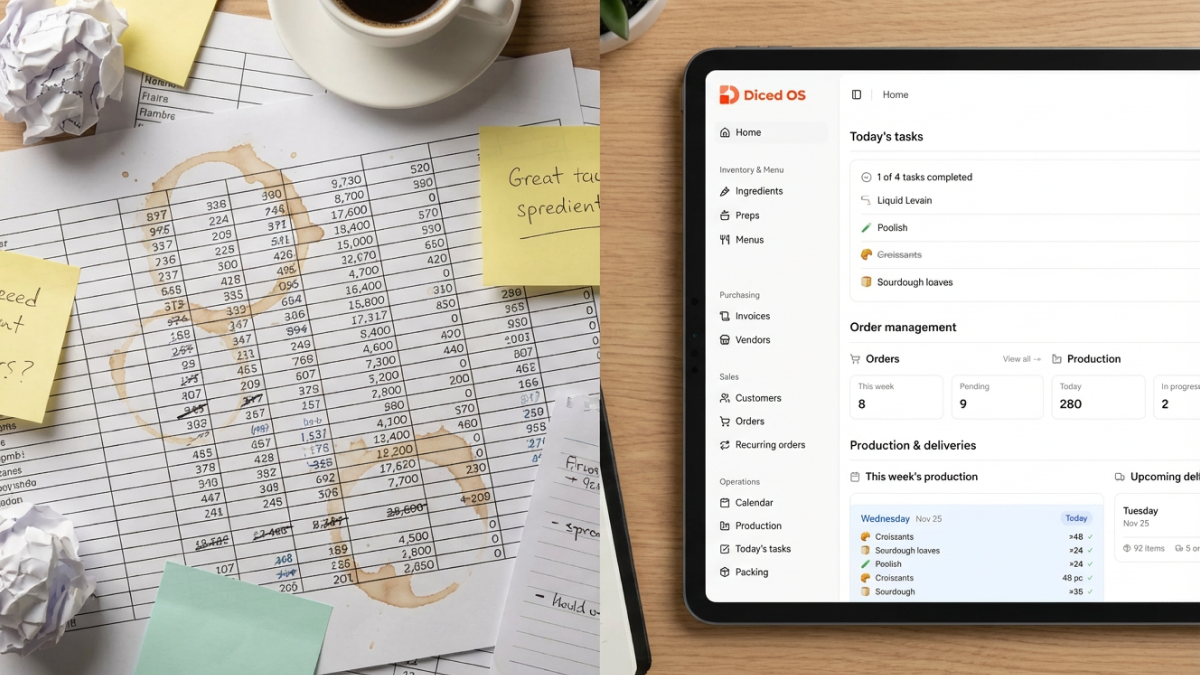
Every bakery owner has tried a costing spreadsheet at some point. Most of those spreadsheets sit abandoned after two weeks—too complicated to maintain, too rigid for real-world changes, or missing crucial information.
A food costing template that actually works needs to balance comprehensiveness with usability. Too simple and it won't capture what you need to know. Too complex and nobody will update it.
Let me walk you through what a practical wholesale bakery costing template looks like—one you might actually use longer than a month.
The Structure That Works
Before diving into fields, let's talk architecture. A bakery costing template needs three connected components:
1. Ingredient Database
A master list of every ingredient you buy, with current pricing. This is your foundation—every recipe pulls from this list.
2. Recipe Cards
Individual calculations for each product, referencing the ingredient database. When ingredient prices change, recipes update automatically.
3. Summary Dashboard
A view that shows profitability across your menu, identifying problems and opportunities.
These three pieces need to talk to each other. That's the key difference between a template you'll use and one you'll abandon.
The Ingredient Database
This is your most important sheet. Get this right and everything else works.
Essential Fields
Ingredient Name Be consistent. Decide on naming conventions and stick to them.
- Bad: "Bread flour," "BF," "King Arthur bread flour," "bread flour (KABF)"
- Good: "Flour, bread" or "Bread flour - King Arthur"
Pick one approach. Use it everywhere.
Purchase Unit How you buy it from your supplier.
- 50 lb bag
- Case of 12 × 1 lb
- 36 count flat (eggs)
Purchase Price What you pay per purchase unit. Update this when invoices change.
Recipe Unit How your recipes measure this ingredient.
- grams
- ounces
- each (for eggs, vanilla beans)
Conversion Factor How to convert from purchase unit to recipe unit.
- 50 lb bag = 22,680 grams
- 36 eggs = 36 each
Cost Per Recipe Unit Calculated: Purchase Price ÷ Conversion Factor
Example Entries:
| Name | Purchase Unit | Price | Recipe Unit | Conversion | Cost/Unit |
|---|---|---|---|---|---|
| Flour, bread | 50 lb bag | $32.50 | gram | 22,680 | $0.00143 |
| Butter, unsalted | Case 36 lb | $234.00 | gram | 16,329 | $0.01433 |
| Eggs, large | Flat of 36 | $12.60 | each | 36 | $0.35000 |
| Sugar, granulated | 50 lb bag | $45.00 | gram | 22,680 | $0.00198 |
| Yeast, fresh | 1 lb block | $3.50 | gram | 454 | $0.00771 |
Optional but Useful Fields
Supplier: Where you buy it Last Updated: When you last changed the price Minimum Order: Quantity requirements from supplier Lead Time: How far ahead you need to order Category: Grouping for analysis (dairy, dry goods, etc.)
The Update Discipline
Your ingredient database is only as good as your update frequency. When your butter invoice shows a price change:
- Update the purchase price in your database
- Every recipe using butter automatically recalculates
- Check your margin on high-butter items
- Decide if pricing adjustment is needed
Most bakeries should review and update prices monthly at minimum. Wholesale operations with tight margins should update within days of receiving invoices.
The Recipe Card Structure
Each product gets its own recipe card. For a spreadsheet template, this often means one sheet per recipe or a large sheet with multiple recipe sections.
Essential Fields
Recipe Name: Clear, consistent with how you refer to it Yield: Number of finished units (24 croissants, 6 loaves, etc.) Yield Weight: Total batch weight (useful for scaling)
Ingredient Table:
- Ingredient name (linked to database)
- Quantity in recipe units
- Cost (calculated from database)
Total Ingredient Cost: Sum of all ingredients
Cost Per Unit: Total cost ÷ yield
Example Recipe Card:
Classic Croissant Yield: 24 pieces
| Ingredient | Amount | Unit | Cost |
|---|---|---|---|
| Flour, bread | 500 | gram | $0.72 |
| Milk, whole | 250 | gram | $0.28 |
| Sugar, granulated | 60 | gram | $0.12 |
| Salt, fine | 10 | gram | $0.01 |
| Yeast, fresh | 12 | gram | $0.09 |
| Butter, unsalted (dough) | 50 | gram | $0.72 |
| Butter, unsalted (lamination) | 280 | gram | $4.01 |
| Eggs, large (wash) | 0.5 | each | $0.18 |
| Total | $6.13 |
Cost per croissant: $0.26
Extended Fields for Wholesale
Labor Time: Active production time per batch Labor Cost: Time × labor rate Packaging Cost: Per-unit packaging materials Overhead Allocation: Share of fixed costs Total Cost: Ingredients + labor + packaging + overhead Selling Price: Current price point Margin $: Price - total cost Margin %: Margin $ ÷ price
With these additions, the croissant card becomes:
| Component | Per Batch | Per Unit |
|---|---|---|
| Ingredients | $6.13 | $0.26 |
| Labor (90 min @ $22/hr) | $33.00 | $1.38 |
| Packaging | $4.80 | $0.20 |
| Overhead | $6.00 | $0.25 |
| Total Cost | $49.93 | $2.09 |
| Selling Price | $3.50 | |
| Margin | $1.41 (40%) |
Now you can see whether $3.50 is a reasonable wholesale price.
Sub-Recipes: The Secret Sauce
Here's where most templates fail wholesale bakeries.
Your croissant uses laminated dough. So does your pain au chocolat. And your almond croissant. And your ham and cheese croissant.
If each recipe repeats the laminated dough ingredients, you have four places to update when butter prices change. And they'll inevitably get out of sync.
The Sub-Recipe Solution
Create a recipe for "Laminated Croissant Dough" as its own item. This sub-recipe appears in your ingredient database alongside flour and butter.
Sub-Recipe: Laminated Croissant Dough Yield: 1,400g finished dough
| Ingredient | Amount | Unit | Cost |
|---|---|---|---|
| Flour, bread | 500 | gram | $0.72 |
| Milk, whole | 250 | gram | $0.28 |
| Sugar, granulated | 60 | gram | $0.12 |
| Salt, fine | 10 | gram | $0.01 |
| Yeast, fresh | 12 | gram | $0.09 |
| Butter, unsalted (dough) | 50 | gram | $0.72 |
| Butter, unsalted (lamination) | 280 | gram | $4.01 |
| Total | 1,162 | gram | $5.95 |
Cost per gram: $0.00512
Now your croissant recipe becomes:
| Ingredient | Amount | Unit | Cost |
|---|---|---|---|
| Laminated croissant dough | 50 | gram | $0.26 |
| Eggs, large (wash) | 0.02 | each | $0.01 |
| Total per croissant | $0.27 |
When butter prices change, you update it once in the ingredient database. The laminated dough sub-recipe recalculates. Every product using that dough automatically updates.
Common Sub-Recipes for Bakeries
- Laminated dough (croissant, Danish, puff)
- Frangipane (almond croissants, Danish fillings)
- Pastry cream (Danish, cream puffs, tarts)
- Crumble topping (muffins, coffee cakes)
- Sourdough starter (all sourdough products)
- Simple syrup (glazes, soaking)
- Chocolate ganache (cakes, truffles)
Each becomes an "ingredient" other recipes reference.
The Summary Dashboard
Raw recipe data is useful. A dashboard that surfaces insights is powerful.
What to Display
Menu Overview Table:
| Product | Cost | Price | Margin $ | Margin % | Weekly Units | Weekly Profit |
|---|---|---|---|---|---|---|
| Croissant | $2.09 | $3.50 | $1.41 | 40% | 200 | $282 |
| Sourdough | $3.85 | $5.50 | $1.65 | 30% | 150 | $248 |
| Cookie 6-pk | $2.10 | $8.00 | $5.90 | 74% | 80 | $472 |
| ... |
Key Metrics:
- Total weekly revenue
- Total weekly cost
- Gross profit
- Average margin %
- Highest-margin item
- Lowest-margin item
- Items below target margin
Trend Tracking: If you're updating monthly, track margin % over time. A declining trend indicates ingredient costs are outpacing prices.
Alerts and Flags
Build conditional formatting into your template:
- Red flag for items under 20% margin
- Yellow flag for items 20-25%
- Green for items over 25%
These visual cues make problems obvious at a glance.
Template Maintenance
A template only works if you maintain it. Here's a realistic maintenance schedule:
Weekly (10 minutes)
- Update any ingredient prices that changed
- Spot-check one or two recipes for accuracy
- Review dashboard for flagged items
Monthly (30-60 minutes)
- Full review of ingredient database prices
- Compare theoretical vs. actual costs (if you track inventory)
- Update yields for recipes with known variation
- Review and update labor time estimates
Quarterly (2-3 hours)
- Audit all recipes for accuracy
- Remove discontinued items
- Add new products
- Review pricing against updated costs
- Document changes for trend analysis
Annually (Half day)
- Complete overhaul of ingredient database
- Verify all supplier pricing
- Review labor rates and update
- Adjust overhead allocations
- Compare year-over-year cost trends
Common Template Mistakes
Mistake 1: Too Many Fields
Your template doesn't need fields for allergens, storage location, prep instructions, and supplier contact info. Those belong elsewhere. Costing templates should focus on costs.
Mistake 2: Manual Calculations
Every calculation should be a formula. If someone's typing "=0.72+0.28+0.12" by hand, it will break.
Mistake 3: No Sub-Recipes
Every bakery has shared components. Build sub-recipes or spend forever updating redundant data.
Mistake 4: Outdated Prices
A template with six-month-old prices is worse than no template—it provides false confidence in incorrect numbers.
Mistake 5: No Backup
Your costing template represents hours of work. Back it up. Use cloud storage with version history. Don't be the person who loses everything to a corrupted file.
Spreadsheet vs. Free Food Cost Calculator App
Should you build a spreadsheet template or use a free food cost calculator app?
Build a spreadsheet if:
- You want complete control over calculations
- You have fewer than 30 recipes
- You're comfortable with Excel/Sheets formulas
- You need custom analysis not available in apps
- You want to truly understand the numbers
Use an app if:
- You don't want to build formulas
- You need mobile access regularly
- You have 30+ recipes to track
- You want guided setup
- You're willing to work within the app's limitations
For many wholesale bakeries, the right answer is: start with a spreadsheet to understand the concepts, then migrate to purpose-built software as you scale.
Getting Started
If you're building a template from scratch:
Day 1: Create ingredient database with your 20 most-used ingredients Day 2: Build recipe cards for your top 5 products Week 1: Expand to all active products Week 2: Add sub-recipes for shared components Week 3: Build summary dashboard Week 4: Establish maintenance routine
The goal isn't perfection. The goal is a working system you'll actually maintain.
Start simple. Add complexity only as needed. A basic template you update regularly beats an elaborate one gathering dust.
Want the power of a sophisticated costing system without building spreadsheet formulas? Visit dicedos.com to see how our platform handles recipe costing, sub-recipes, and automatic price updates—all without spreadsheet maintenance.
Related posts
Top 5 Free Food Costing Apps for Small Bakeries
The Best Free Food Cost Calculator for Bakeries
Recipe Costing for Bakeries: How to Price Your Baked Goods for Maximum Profitability
Bakery Ingredient Price Variance Report: Catch Cost Changes Before They Hit Margin