The Best Free Food Cost Calculator for Bakeries
Published: May 19, 2025
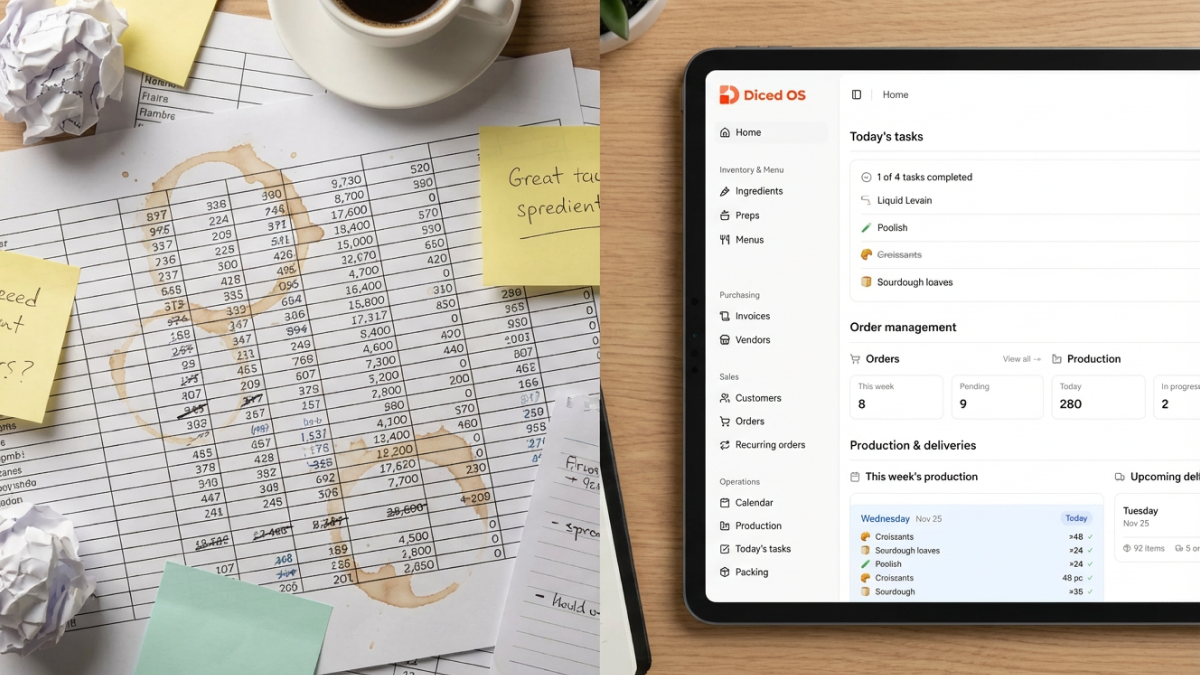
I've watched bakery owners scribble numbers on napkins, build elaborate spreadsheets that nobody updates, and wing their pricing based on what feels right. Some of them run profitable businesses. Most don't realize they're losing money on their best-selling items until it's too late.
A free food cost calculator won't solve all your problems. But it will tell you the truth about your margins—and that truth is worth knowing before you sign another lease or hire another employee.
Why Bakeries Need Cost Calculators More Than Restaurants
Restaurants have it easier. A burger is a burger. The patty costs what it costs, the bun is the bun, and your food cost percentage stays relatively predictable across service.
Bakeries are different. You're dealing with:
- Yield variations that change with humidity, altitude, and whether your baker had coffee that morning
- Ingredient costs that swing wildly—butter went from $3/lb to $6/lb in some markets over the past two years
- Labor-intensive products where shaping time matters as much as ingredient costs
- Batch economics that make a single croissant cost very different from a batch of 24
A calculator built for restaurants won't capture these nuances. A free food cost calculator designed for bakery operations will.
What a Good Calculator Actually Does
Let me be specific about what "good" means here.
Handles Weight-Based Measurements
If your calculator asks for "cups of flour," close the tab. Professional bakeries measure by weight—grams or ounces—because volume measurements are wildly inconsistent.
A proper food costing template should let you enter:
- 500g bread flour at $0.65/kg
- 280g European butter at $7.50/kg
- 12g fresh yeast at $8.00/kg
Then it should calculate the cost per unit automatically, handling the unit conversions so you don't have to.
Accounts for Yield Loss
Here's a number that surprised me when I first learned it: a typical croissant recipe loses 5-8% of dough weight during lamination and shaping. Trimmed edges, dough that sticks to the bench, scraps that can't be rerolled.
If your batch makes 24 croissants on paper but you're consistently pulling 22 out of the oven, your per-unit cost is 9% higher than you calculated.
Good calculators let you input an expected yield percentage. Great ones track actual vs. theoretical yield over time.
Separates Ingredient Cost from Total Cost
This is where most free tools fall short.
Your ingredient cost for a loaf of sourdough might be $1.20. But that's not what the loaf costs you. Add in:
- Labor (30 minutes of active time across mixing, shaping, and baking at $20/hour = $10 per batch of 6 loaves = $1.67 per loaf)
- Packaging ($0.35 for a kraft bag)
- Overhead allocation (rent, utilities, equipment depreciation—typically $0.50-1.00 per item for small bakeries)
That $1.20 ingredient cost becomes a $3.72 total cost. If you're selling at $5.00, your margin is $1.28, not $3.80.
A food cost calculator app free of charge might only show you ingredient costs. That's better than nothing, but it's not the whole picture.
The Features That Actually Matter
After watching dozens of bakeries try different tools, here's what separates useful calculators from shelf-ware:
1. Recipe Scaling
You developed your chocolate chip cookie recipe at home in batches of 24. Now you need to make 150 for a catering order. A good calculator scales everything automatically—not just multiplying by 6.25, but flagging when scaled quantities hit awkward numbers (like 1.875 eggs) or exceed standard equipment capacity.
2. Ingredient Price Updates
Butter was $4.50/lb last month. It's $5.20/lb this month. When you update butter's price, every recipe using butter should recalculate automatically.
This sounds obvious, but many food costing templates require you to manually update each recipe when prices change. That's fine if you have 10 recipes. It's a nightmare with 50.
3. Sub-Recipe Support
Your croissant uses laminated dough. Your pain au chocolat uses the same dough. Your almond croissant uses the same dough plus frangipane.
A calculator that doesn't support sub-recipes (or "prep recipes") forces you to duplicate your laminated dough costs across every product. When butter prices change, you're updating 15 different recipes instead of one.
4. Cost History
What did flour cost you in March? How much has butter increased year-over-year? These questions matter for pricing decisions and contract negotiations with suppliers.
Most free food cost calculators don't track history. They show you today's numbers only. That's a limitation worth knowing about.
5. Export Capability
Can you get your data out? Into a spreadsheet? Into your accounting software?
Free tools often lock your data inside their system. That's fine until you want to switch tools or run analysis they don't support.
Common Mistakes When Using Cost Calculators
The tool is only as good as the data you feed it. Here's where bakery owners typically go wrong:
Using Retail Prices for Ingredients
You're not paying grocery store prices. Use your actual invoice prices—the wholesale cost per unit from your supplier, after any discounts.
Forgetting Small Ingredients
Salt costs almost nothing per recipe. So does vanilla. And baking powder. And the egg wash.
Add them all up across your menu and you're looking at hundreds of dollars monthly that didn't make it into your cost calculations.
Not Accounting for Waste
Every bakery has waste. Bread that doesn't sell, croissants that come out flat, cookies that burn. Industry average is 3-5% for well-run operations, higher for bakeries still dialing in their production.
Your calculator shows you theoretical costs. Reality includes waste.
Ignoring Labor on "Simple" Items
A chocolate chip cookie seems simple. But someone had to portion the dough, pan it, bake it, cool it, and package it. If that takes 3 minutes per cookie at $18/hour, you're adding $0.90 in labor cost.
Free vs. Paid: What You're Actually Getting
Let's be honest about what free tools provide.
Most free food cost calculator options offer:
- Basic ingredient costing
- Simple recipe storage
- Manual calculations
- Limited recipe count (often 10-25 recipes)
What you typically need to pay for:
- Automatic price updates from invoices
- Sub-recipe support
- Yield tracking
- Labor cost integration
- Multi-location support
- Detailed reporting
For a home baker selling at farmers markets, free is probably fine. For a wholesale bakery with 50+ products shipping to multiple accounts, free tools create more work than they save.
The question isn't "is free good enough?" It's "what's the cost of inaccurate data?"
If you're underpricing your best-seller by $0.50 and selling 200 units daily, that's $100/day in lost margin—$36,500 annually. A paid tool that costs $50/month pays for itself in three days.
What to Look For in a Food Costing Template
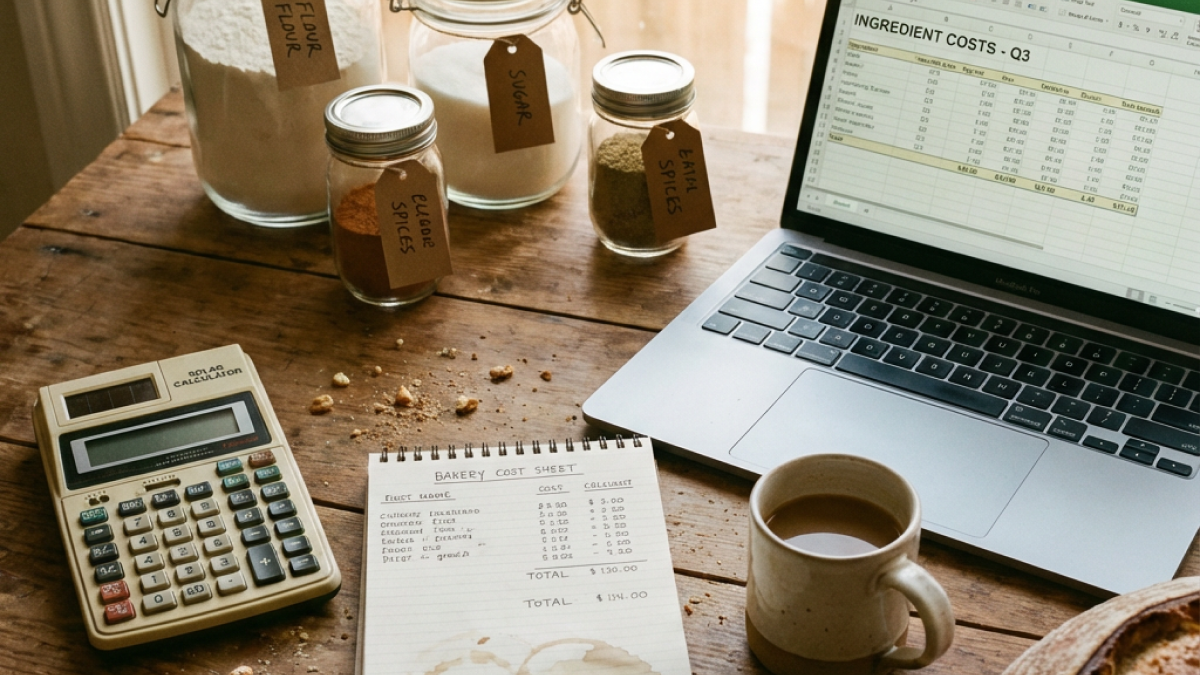
If you're starting with spreadsheets (and many successful bakeries still use them), here's what your template needs:
Ingredient Database Tab
- Ingredient name
- Purchase unit (case, bag, pound)
- Purchase price
- Recipe unit (gram, ounce, each)
- Cost per recipe unit (calculated)
Recipe Tab
- Recipe name
- Yield (number of units)
- Ingredient list with quantities
- Total ingredient cost (calculated)
- Cost per unit (calculated)
Pricing Tab
- Recipe name
- Ingredient cost per unit
- Labor cost per unit
- Packaging cost per unit
- Overhead allocation
- Total cost per unit
- Target margin %
- Calculated selling price
- Actual selling price
- Actual margin %
The formulas aren't complicated. The discipline of updating them consistently is.
Real Numbers: What Good Costing Reveals
Let me share an example from a bakery I worked with last year.
They had a popular apple danish selling at $4.50. Their gut feeling: it was profitable because it sold well and used relatively cheap ingredients.
When we ran the actual numbers:
| Component | Cost |
|---|---|
| Danish dough (sub-recipe) | $0.42 |
| Apple filling (sub-recipe) | $0.38 |
| Streusel topping | $0.12 |
| Glaze | $0.08 |
| Total ingredients | $1.00 |
| Labor (8 min @ $20/hr) | $2.67 |
| Packaging | $0.25 |
| Overhead | $0.75 |
| Total cost | $4.67 |
They were losing $0.17 on every danish sold. Their best-seller was their biggest money loser.
The fix was simple: raise the price to $5.50 (still competitive) and streamline the filling prep to cut labor time. New margin: $0.58 per unit.
Without a proper calculator, they'd have kept losing money indefinitely.
Making the Switch: From Guessing to Knowing
Here's a realistic path for bakeries currently flying blind:
Week 1: Gather Invoice Data Pull your last three months of supplier invoices. Create a list of every ingredient you buy regularly with current prices.
Week 2: Document Your Top 10 Recipes Don't try to cost everything at once. Start with your highest-volume items. Weigh everything, time the labor, note the yield.
Week 3: Set Up Your Calculator Whether it's a free food cost calculator, a paid platform, or a well-built spreadsheet—enter your data. Calculate your true costs.
Week 4: Analyze and Adjust Compare your calculated costs to your current prices. Identify the losers. Make decisions.
Most bakeries find at least one "profitable" item that's actually losing money, and at least one underpriced item with room to increase margins.
The Bottom Line
A free food cost calculator is a good starting point. It's infinitely better than guessing. It'll show you which items deserve attention and where your assumptions might be wrong.
But understand its limitations. Free tools typically don't handle the complexity of professional bakery operations—sub-recipes, yield variations, labor tracking, price history. At some point, you'll either outgrow them or build elaborate workarounds.
The best calculator is one you actually use. Pick something that matches your current scale, commit to keeping it updated, and let the numbers guide your decisions.
Your croissants might be beautiful. But if they're not profitable, beauty doesn't pay the rent.
Ready to move beyond spreadsheets? Visit dicedos.com to see how our platform handles recipe costing, ingredient tracking, and profitability analysis—all designed specifically for bakery operations.
Related posts
The Complete Guide to Food Cost Percentage for Bakeries
Recipe Costing for Bakeries: How to Price Your Baked Goods for Maximum Profitability
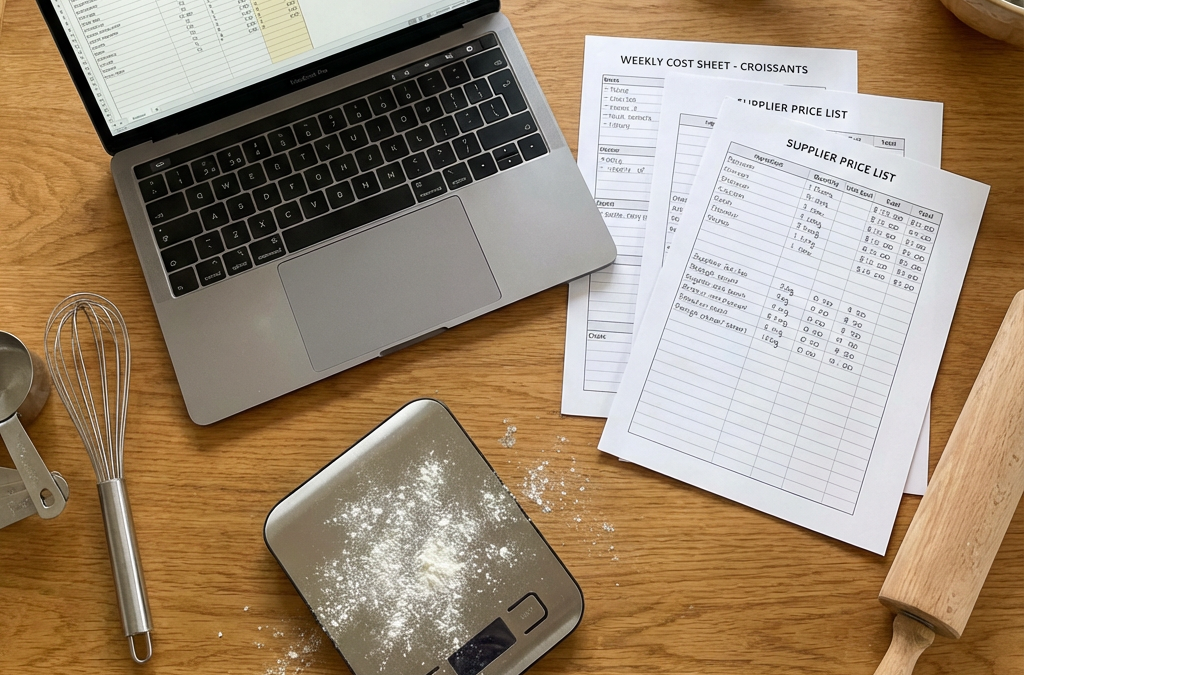
Free Food Costing Template for Wholesale Bakeries
Why Cost Management Matters for Small Bakeries: The Complete 2025 Guide