The Complete Guide to Food Cost Percentage for Bakeries
Published: July 12, 2025
Ask a bakery owner their food cost percentage and you'll get one of three answers:
- A confident number that's probably wrong
- "I'm not sure, maybe around 30%?"
- Blank stare
Food cost percentage is supposedly basic business math, but I've met bakery owners with 10 years of experience who've never calculated it correctly. They know their recipes. They know their prices. They've never connected the dots.
Let's fix that.
The Basic Formula
Food cost percentage tells you what portion of your selling price goes to ingredients.
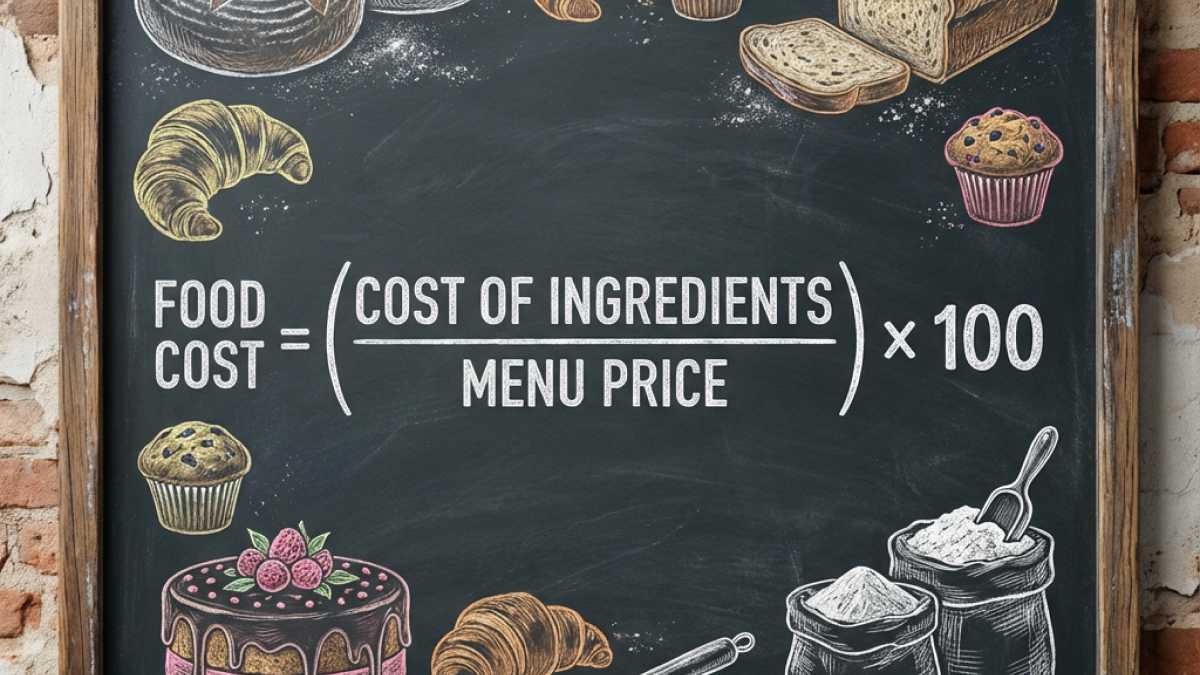
Formula: Food Cost % = (Ingredient Cost / Selling Price) × 100
Example: A croissant costs $0.85 in ingredients and sells for $4.00. Food Cost % = ($0.85 / $4.00) × 100 = 21.25%
That's it. The formula itself is simple.
What gets complicated is knowing what numbers to put into the formula—and understanding what the result actually means.
What Goes Into "Ingredient Cost"?
This is where confusion starts.
The Narrow Definition (What Most People Use)
Raw ingredients only. Flour, butter, eggs, sugar. The stuff you weigh and mix.
For a croissant:
- Bread flour: $0.19
- Butter (including lamination): $0.48
- Milk: $0.06
- Sugar: $0.03
- Yeast: $0.04
- Salt: $0.01
- Egg wash: $0.04
- Total: $0.85
The Expanded Definition (What You Should Use)
Include everything consumed in making the product:
- Raw ingredients
- Release spray/pan grease
- Dusting flour
- Parchment paper
- Packaging materials (if included before sale)
These "invisible" costs add $0.05-0.20 per item in many bakeries. That $0.85 croissant might actually be $1.00-1.05 when you count everything.
What NOT to Include
Food cost percentage is specifically about ingredients and consumables. It doesn't include:
- Labor
- Rent
- Utilities
- Equipment
- Delivery costs
Those matter for profitability, but they're not "food cost."
Target Food Cost Percentages for Bakeries
Different products have different targets. Here's a realistic guide:
Bread Products: 20-30%
Bread is flour-heavy, and flour is cheap. Even artisan loaves with long fermentation should hit 25-30% food cost.
| Product | Typical Food Cost % |
|---|---|
| Basic white bread | 18-22% |
| Sourdough | 20-25% |
| Specialty bread (seeds, grains) | 25-30% |
| Enriched bread (brioche) | 28-35% |
Pastry/Viennoiserie: 18-28%
Butter and eggs push costs higher, but so do prices.
| Product | Typical Food Cost % |
|---|---|
| Croissant | 18-24% |
| Pain au chocolat | 22-28% |
| Danish | 20-26% |
| Almond croissant | 25-32% |
Cookies and Bars: 15-25%
These are often the most profitable items in a bakery.
| Product | Typical Food Cost % |
|---|---|
| Chocolate chip cookie | 15-20% |
| Sugar cookie | 12-18% |
| Brownie | 18-24% |
| Lemon bar | 20-26% |
Cakes and Decorated Items: 25-40%
Labor-intensive, but ingredient costs can also be high.
| Product | Typical Food Cost % |
|---|---|
| Simple layer cake | 25-30% |
| Decorated cake | 28-35% |
| Cheesecake | 30-38% |
| Wedding/custom cake | 30-45% |
The Overall Target
For a bakery as a whole, aggregate food cost percentage should land between 25-35%. Below 25% often means prices are too high or portion sizes are too small. Above 35% usually means you're underpriced, overportioning, or experiencing waste.
Calculating for Your Whole Business
Individual item food cost matters. So does your overall percentage.
The Period Calculation
Formula: Overall Food Cost % = (Beginning Inventory + Purchases - Ending Inventory) / Total Food Sales × 100
Example:
- Beginning inventory: $2,500
- Purchases during month: $12,000
- Ending inventory: $2,800
- Total food sales: $42,000
Cost of Goods Sold = $2,500 + $12,000 - $2,800 = $11,700 Food Cost % = $11,700 / $42,000 × 100 = 27.9%
This tells you what actually happened, not what should have happened theoretically.
Theoretical vs. Actual
Theoretical food cost: What your costs should be based on recipes and sales mix, assuming zero waste and perfect portioning.
Actual food cost: What you actually spent on ingredients divided by what you actually sold.
The gap between these numbers is variance. Some variance is normal—maybe 1-3%. Larger variance indicates problems: waste, theft, over-portioning, or inaccurate recipes.
If your theoretical is 26% but actual is 32%, you're losing 6% of revenue to variance. On $40,000 monthly sales, that's $2,400 walking out the door.
Common Mistakes
I've seen all of these many times:
Mistake 1: Using Retail Ingredient Prices
Your cost calculation should use YOUR costs from YOUR suppliers. Not grocery store prices, not online prices, not what you paid two years ago.
If you're calculating croissant cost using butter at $5/lb but you're actually paying $7.50/lb, your food cost percentage is fiction.
Mistake 2: Ignoring Yield Loss
Your dough recipe makes 24 croissants on paper. You consistently get 22 from a batch. If you're calculating cost based on 24, you're understating by 8%.
Use actual yield, not theoretical yield.
Mistake 3: Forgetting Invisible Ingredients
The egg wash shared across 30 croissants. The dusting flour. The pan spray. The parchment. These are real costs that belong somewhere.
Mistake 4: Not Updating for Price Changes
Butter was $5.50/lb when you built your recipes. It's $7.00/lb now. If you haven't updated your cost calculations, your "27% food cost" is actually 33%.
Mistake 5: Inconsistent Portioning
Your recipe says 80g per cookie. Your team scoops anywhere from 75g to 95g. That variance swings your food cost 15-20% from one batch to the next.
Standardization isn't just about consistency for customers—it's about knowing your actual costs.
Mistake 6: Mixing Up Cost and Margin
Food cost percentage tells you what portion of selling price goes to ingredients.
Gross margin tells you what portion stays as gross profit.
If food cost is 25%, gross margin is 75%.
These are inversely related. Don't confuse them—"we're at 25%" means very different things depending on which metric you're discussing.
Using Food Cost Percentage for Pricing
The most practical application: setting prices.
The Markup Method
If you know your target food cost percentage, you can work backward to price:
Formula: Selling Price = Ingredient Cost / Target Food Cost %
Example: Croissant ingredient cost: $0.85 Target food cost: 22%
Selling Price = $0.85 / 0.22 = $3.86
Round to $3.95 or $4.00 for practical pricing.
The Reality Check Method
You set prices based on competition and perceived value. Food cost percentage checks whether those prices work.
Example: You want to price croissants at $3.75 (competitive in your market). Ingredient cost: $0.85
Food Cost % = $0.85 / $3.75 × 100 = 22.7%
Is 22.7% acceptable? For a croissant, yes. If this calculation returned 38%, you'd know the price doesn't work.
Why Food Cost Percentage Isn't Everything
Here's where bakery owners get tripped up.
Food cost percentage measures efficiency of ingredient spending. It doesn't measure profitability.
Example:
| Item | Price | Ingredient Cost | Food Cost % | Gross Profit $ |
|---|---|---|---|---|
| Cookie | $3.00 | $0.45 | 15% | $2.55 |
| Croissant | $4.50 | $0.90 | 20% | $3.60 |
| Cake slice | $7.50 | $2.50 | 33% | $5.00 |
The cookie has the best food cost percentage. The cake slice generates the most profit dollars.
If you optimize purely for food cost percentage, you'd push cookies and avoid cake. But cake contributes more to paying rent, labor, and yourself.
The lesson: food cost percentage is one metric, not the only metric. Use it alongside:
- Gross profit dollars per item
- Profit per labor hour
- Profit per production capacity unit
Tracking Over Time
One-time calculation teaches you about your recipes. Ongoing tracking teaches you about your operation.
Monthly Tracking
Calculate overall food cost percentage monthly:
- Pull beginning and ending inventory
- Add up purchases from invoices
- Divide by total food sales
Compare to previous months. Look for trends.
Variance Investigation
If food cost jumps from 28% to 33%, ask why:
- Did ingredient prices increase?
- Did sales mix shift to higher-cost items?
- Did waste increase?
- Is theft possible?
- Were there portion control problems?
The number doesn't tell you what's wrong—but it tells you something is.
Seasonal Patterns
Food cost often varies seasonally:
- Summer: Fresh fruit items push costs higher
- Holiday: Premium ingredients for special items
- Slow periods: Waste percentage increases
Know your patterns so you don't panic at normal seasonal shifts.
Tools for Tracking
Food Cost App Free Options
Most free food costing tools calculate per-recipe percentages but don't track overall business metrics over time. They're useful for initial pricing decisions but limited for ongoing management.
Spreadsheet Approach
A well-built spreadsheet can track:
- Monthly inventory, purchases, and sales
- Rolling food cost percentage
- Item-level food cost calculations
- Variance analysis
Time-consuming to maintain but free and customizable.
Integrated Platforms
Purpose-built bakery software connects:
- Recipe costing with automatic updates when ingredient prices change
- Production tracking for actual output
- Standing order automation for recurring customers
- Automatic calculation of theoretical vs. actual variance
More investment upfront, less manual work ongoing.
Taking Action
Understanding food cost percentage is step one. Acting on it is step two.
If Your Food Cost Is Too High
Above 40% overall: Serious problem. Either prices are too low or waste is extreme.
- Audit your top 10 items for accurate costing
- Check actual vs. theoretical yield
- Review pricing against competitors
- Implement portion control
35-40%: Marginal. Room for improvement.
- Identify highest food-cost items
- Negotiate with suppliers or find alternatives
- Reduce waste through better production planning
- Consider modest price increases
If Your Food Cost Is Too Low
Below 20% overall: You might be leaving money on the table—or portions are too small.
- Are prices significantly above market?
- Are customers commenting on portion sizes?
- Could you improve quality with better ingredients?
If You Don't Know Your Food Cost
This is the most common situation. Start here:
- Pick your top 5 items by sales volume
- Calculate accurate ingredient costs for each
- Calculate food cost percentage for each
- Compare to targets for that product category
- Expand to full menu over time
Don't try to cost 50 items at once. Start with what matters most.
The Bottom Line
Food cost percentage is fundamental. Every bakery owner should know:
- Their overall food cost percentage (monthly)
- Food cost percentage for their top items
- Target ranges for their product categories
- How to use the number for pricing decisions
It's not the only metric that matters. It doesn't tell the whole profitability story. But it's the starting point for understanding whether your prices and portions make sense.
Get this number right, and everything else gets clearer.
Want automatic food cost tracking without the manual spreadsheet work? Visit dicedos.com to see how our platform calculates recipe costs, tracks ingredient prices, and monitors your food cost percentage over time.
Related posts
The Best Free Food Cost Calculator for Bakeries
Recipe Costing for Bakeries: How to Price Your Baked Goods for Maximum Profitability
Why Cost Management Matters for Small Bakeries: The Complete 2025 Guide
Menu Profit Analysis for Wholesale Bakeries