Beginner-Friendly Inventory Costing for Small Bakeries
Published: May 13, 2025
Let's be honest: "inventory costing" sounds like something accountants do, not bakers. It conjures images of spreadsheets, formulas, and hours of tedious counting.
The reality is simpler. Inventory costing is just knowing what you have and what it's worth. You probably already do an informal version—you know when you're low on flour, you notice when butter seems more expensive than usual.
Formalizing that informal knowledge turns it into a tool for running your bakery better.
Why Bother?
Before getting into the how, let's talk about why.
Know What You're Spending
If you don't track inventory, you only know what you bought—not what you used. You might order $3,000 in ingredients monthly and assume that's your food cost.
But what if $400 of that is still sitting in your freezer? Or what if you used up $200 from last month? Your actual food cost is different from your purchases.
Inventory tracking reveals what you actually consumed.
Catch Problems Early
Without inventory tracking, problems hide:
- Theft goes unnoticed
- Waste isn't quantified
- Over-ordering ties up cash
- Under-ordering disrupts production
Regular inventory counts surface these issues before they become crises.
Make Better Decisions
When you know what you have and what it's worth, you can:
- Price products based on actual costs
- Order the right amounts at the right time
- Identify items to use before they spoil
- Understand true profitability
It's Not Optional Eventually
If your bakery grows, proper inventory management becomes essential. Tax requirements, loan applications, potential sale of the business—all require accurate inventory records.
Starting the habit now is easier than retrofitting it later.
The Basics: What to Track
Your Ingredient List
Start with the items that matter most. For most bakeries, that's:
High-value items: Butter, chocolate, nuts, specialty ingredients. These represent significant money sitting on your shelves.
High-volume items: Flour, sugar, eggs. You use a lot; variations matter in aggregate.
Perishables: Items that spoil quickly. Tracking helps minimize waste.
You don't need to track every sprinkle and garnish. Focus on ingredients that represent 80%+ of your ingredient spending.
Where to Track
Pick one location and stick with it:
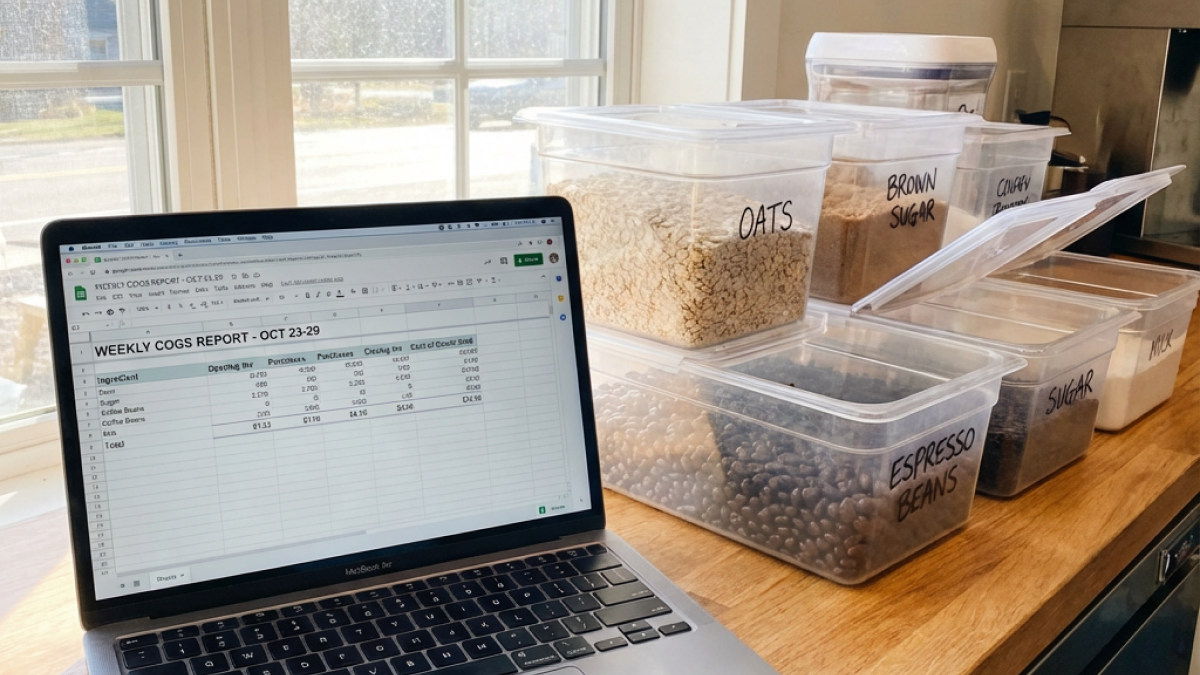
- A spreadsheet (Google Sheets works fine)
- A notebook (low-tech but functional)
- A food costing app free option
- Bakery-specific software
The best system is one you'll actually use consistently.
What Information
For each item, track:
Item name: Clear, consistent naming Unit: How you measure it (pound, kilogram, case, each) Quantity on hand: How many units you have Cost per unit: What you paid most recently Total value: Quantity × cost Location: Where it's stored (optional but helpful)
How to Count
Choose Your Frequency
Options:
- Weekly: Ideal for most bakeries. Often enough to catch problems, not so often it's burdensome.
- Bi-weekly: Acceptable for stable operations with low-value inventory.
- Monthly: Minimum for financial reporting, but problems take longer to surface.
Start with weekly until you understand your patterns. Adjust from there.
Timing Matters
Count at the same time each cycle:
- Same day of week
- Same time of day
- After production ends, before new deliveries
Consistency makes comparisons meaningful. Counting Monday morning one week and Friday evening the next creates false variations.
The Count Process
Step 1: Prepare your count sheet List all items you're tracking. Leave space for quantity.
Step 2: Walk your storage areas systematically Start at one point, work through to another. Don't skip around.
Step 3: Count or weigh each item Full units are easy. Partial bags/containers need estimation.
Step 4: Record immediately Write it down as you count. Don't rely on memory.
Step 5: Calculate values Quantity × cost per unit = value for each item. Sum for total inventory value.
Handling Partial Units
Real bakeries have half-bags of flour and partially used butter cases. Options:
Estimate by weight: Pick up the bag, estimate how full it is. A 50-lb bag that feels half-full is ~25 lbs.
Weigh precisely: If you have a floor scale, use it for high-value items.
Round conservatively: When uncertain, round down rather than up.
Valuing Your Inventory
What's your flour worth? Simple question, but there are different answers.
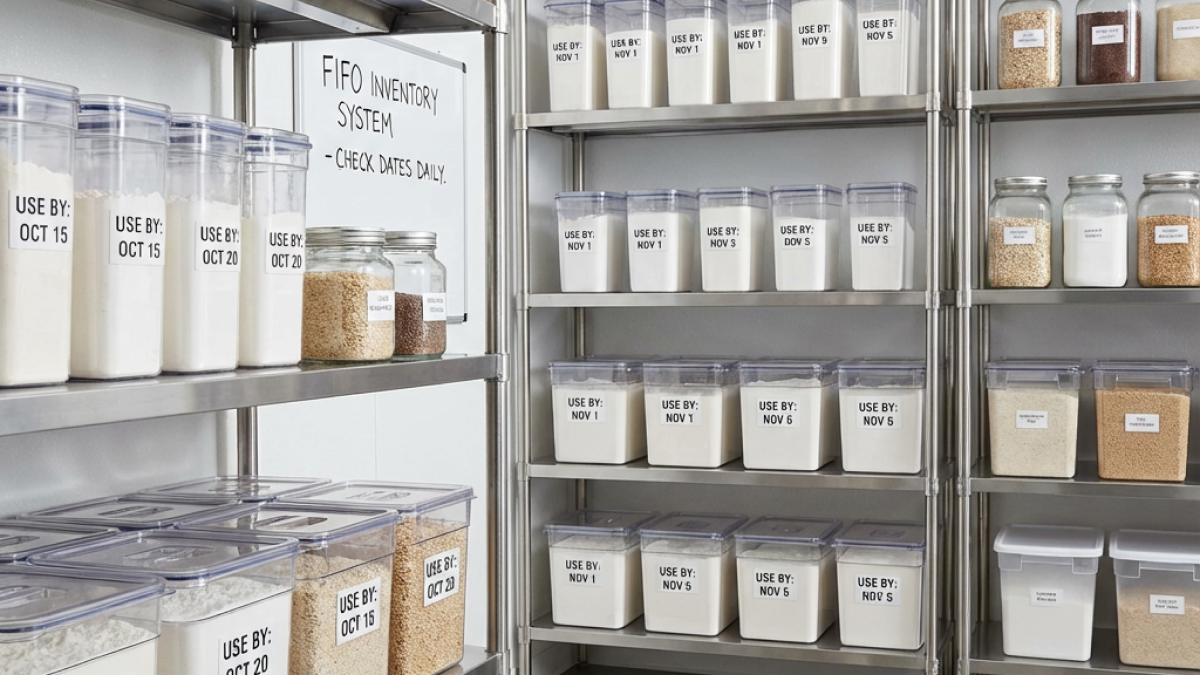
FIFO (First In, First Out)
Assume you use oldest inventory first. Value remaining inventory at most recent purchase prices.
You bought flour at $0.60/lb two months ago, then at $0.65/lb last month. FIFO says the old flour was used; what's left was bought at $0.65/lb.
Most bakeries should use FIFO—it matches how you actually use ingredients (old stuff first).
Current Replacement Cost
Value inventory at what it would cost to replace today.
Simpler than tracking historical prices. Just use your most recent invoice price for each item.
For small bakeries, current replacement cost is practical and usually close enough to FIFO to not matter.
Consistency Matters
Whichever method you choose, use it consistently. Switching methods creates artificial gains or losses that confuse your financial picture.
Connecting Inventory to Food Cost
Here's where inventory counting becomes powerful.
The Calculation
Food Cost = Beginning Inventory + Purchases - Ending Inventory
Example:
- Beginning inventory (start of week): $3,000
- Purchases during week: $1,500
- Ending inventory (end of week): $2,800
Food cost = $3,000 + $1,500 - $2,800 = $1,700
You consumed $1,700 worth of ingredients this week—regardless of what your invoices totaled.
Why This Matters
Compare food cost to food sales:
Food cost percentage = $1,700 / $5,500 sales = 30.9%
Now you know if you're hitting your targets. If you expected 28%, you're over—time to investigate.
Without inventory tracking, you'd only know you bought $1,500 in ingredients. That doesn't tell you what you actually used.
Getting Started: A Simple Template
Here's a basic inventory count sheet:
Inventory Count - Week of [Date]
| Item | Unit | Qty | Cost | Value |
|---|---|---|---|---|
| Flour, bread | lb | 145 | $0.65 | $94.25 |
| Flour, pastry | lb | 85 | $0.72 | $61.20 |
| Butter, unsalted | lb | 48 | $6.80 | $326.40 |
| Sugar, granulated | lb | 95 | $0.55 | $52.25 |
| Eggs | doz | 32 | $4.20 | $134.40 |
| Chocolate chips | lb | 18 | $4.50 | $81.00 |
| Cream, heavy | qt | 12 | $3.25 | $39.00 |
| ... | ||||
| Total | $1,892.50 |
That's it. Count, multiply, sum. The math is elementary school level.
Common Beginner Mistakes
Counting Too Much Detail
You don't need to count individual vanilla beans. Track the bottle—"1.5 bottles @ $12" is accurate enough.
Focus detail on high-value items. Simplify low-value items.
Inconsistent Timing
Counting Wednesday one week, Monday the next, creates meaningless variations. Pick a day/time and protect it.
Not Recording Waste
Items thrown away still affect food cost. If you toss $50 in stale bread, that's not ending inventory anymore—it's consumed inventory (wastefully).
Either track waste separately or adjust ending inventory to exclude trashed items.
Forgetting Storage Areas
The chocolate bars in the office? The backup flour in the basement? The frozen fruit under last year's Christmas decorations?
Walk every storage area every count.
Guessing Instead of Counting
"There's probably $3,000 worth of stuff" isn't counting. Actual counting is tedious but necessary. Approximations compound into significant errors.
Letting It Slide
Skip a week, skip two weeks, suddenly you haven't counted in a month. The habit dies, the data disappears.
Build inventory counting into your routine like cleaning or ordering—non-negotiable.
When to Level Up
Start simple. As your bakery grows, you'll want more:
Par Levels
Know the minimum you need of each item. When inventory drops below par, it's reorder time.
Reorder Points
Par level plus lead time consideration. If it takes 3 days to receive butter and you use 20 lbs/day, reorder when you hit 70 lbs (3 days × 20 lbs + safety).
Purchase Order Integration
Connect inventory counts to ordering. "Inventory is X, par is Y, order Y-X."
Perpetual Inventory
Instead of periodic counts, track every in and out continuously. More accurate, more complex, usually requires software.
Category Analysis
Break down inventory by category. What percentage is tied up in dairy? Dry goods? Frozen? Helps with cash flow management.
Integration with Recipe Costing
Connect inventory values to recipe cost calculations. When butter costs change, all butter-containing recipes automatically update.
A modern kitchen os or food costing app handles this integration automatically.
The Payoff
Inventory costing isn't glamorous. Nobody became a baker because they love counting flour bags.
But the bakeries that do it well have a significant advantage:
- They price accurately
- They waste less
- They order efficiently
- They catch problems early
- They understand their business
The hour you spend counting inventory each week returns many hours of clarity about your bakery's finances.
Start this week. Count what you have. Write it down. Next week, count again. See what changed.
That's inventory costing. It's not complicated. It just requires doing.
Ready to simplify inventory tracking? Visit dicedos.com to see how our platform makes inventory counting faster and automatically connects your inventory to recipe costing and food cost calculations.