The Hidden Costs Inside Supplier Invoices
Published: July 24, 2025
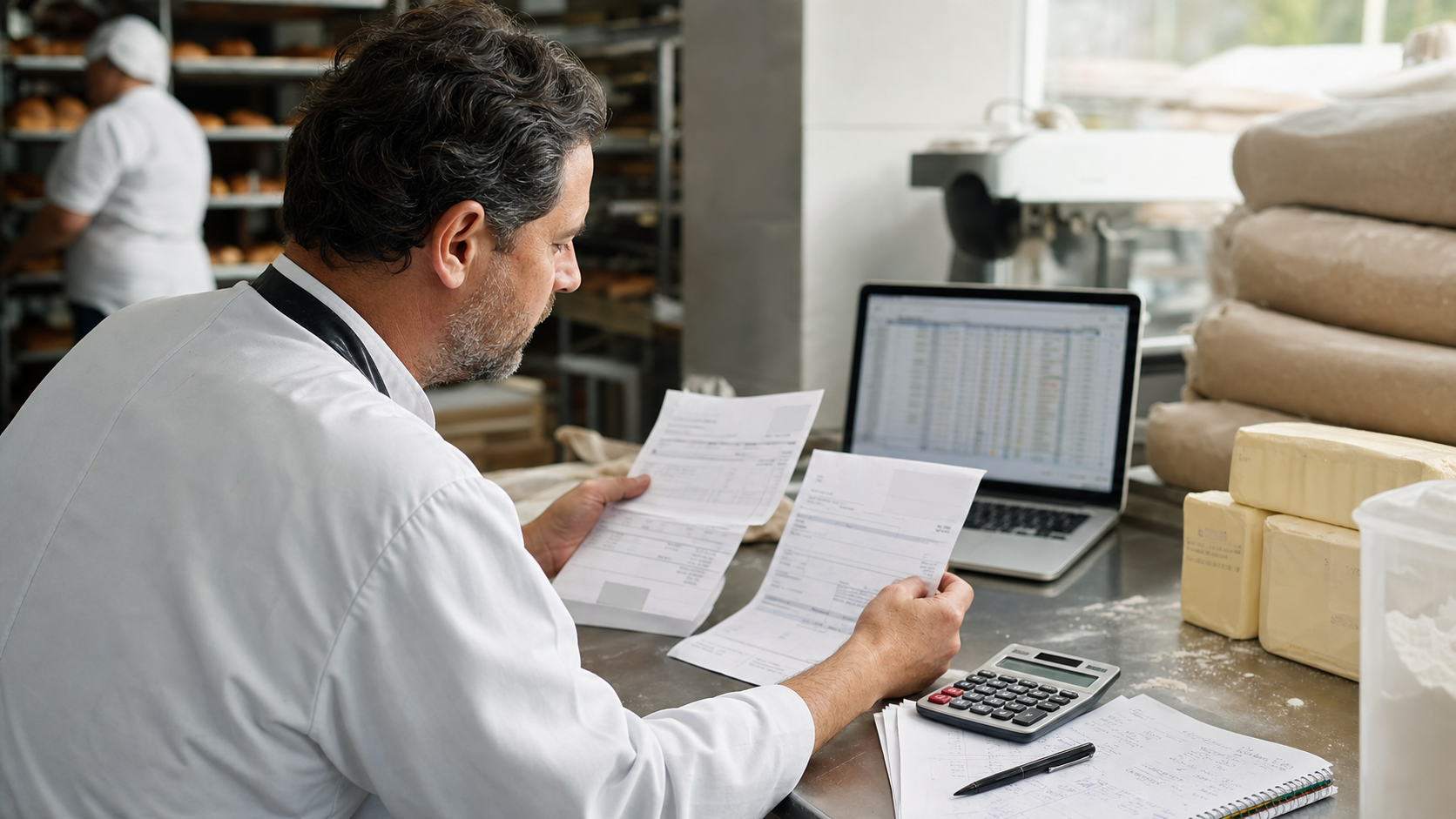
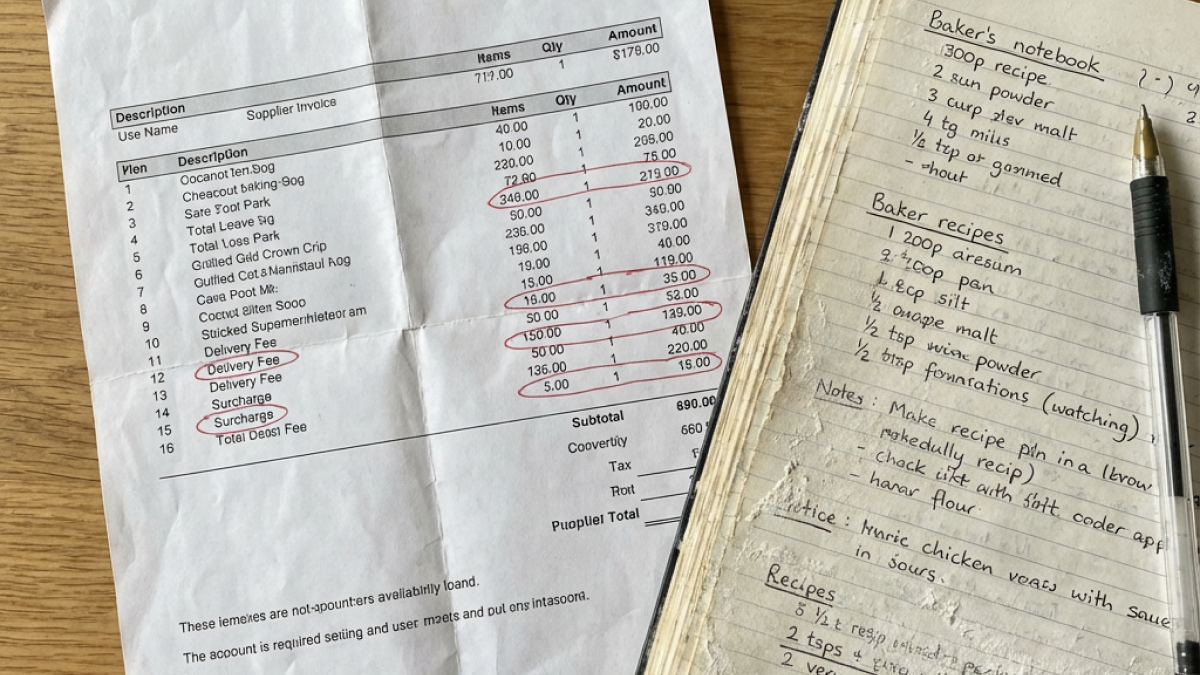
Pull out your most recent supplier invoice. I'll wait.
Now look past the line items for flour and butter and eggs. Look at the bottom section. The small print. The charges that don't have obvious names.
That's where the hidden costs live.
Most bakeries calculate their ingredient costs from the unit prices on their invoices—butter at $6.50/lb, flour at $0.65/lb. They input these numbers into their costing spreadsheets or food cost calculator app and call it accurate.
But those unit prices aren't what you're actually paying. And the difference matters more than you think.
The Anatomy of Real Cost
What you pay for ingredients = Line item cost + Fees + Surcharges + Hidden adjustments
Let's break down where money actually goes.
Fuel Surcharges
Most food distributors add fuel surcharges—percentage-based fees that fluctuate with diesel prices. They're usually listed as a separate line item, often near the bottom of invoices.
Typical range: 2-8% of order value
On a $500 weekly order, a 5% fuel surcharge adds $25. Over a year, that's $1,300 you might not have included in your cost calculations.
The tricky part: fuel surcharges fluctuate. Your $25 charge might become $35 when diesel spikes. Your costing doesn't automatically update.
Delivery Fees
Many distributors charge explicit delivery fees, especially for smaller orders or routes with fewer stops.
Flat fees: $15-50 per delivery, regardless of order size Tiered fees: Free over $500, $25 under $500, $40 under $300 Per-mile fees: Common for specialty suppliers outside normal routes
If you receive two deliveries weekly with $25 fees each, that's $200/month not reflected in your unit costs.
Minimum Order Charges
Order below the minimum threshold? You'll often see a fee to compensate.
"Minimum order: $350. Orders under minimum subject to $45 small order fee."
If you're occasionally placing $275 orders, those $45 fees add up.
Case Charges
Some products have per-case handling charges—especially frozen items, refrigerated goods, or products requiring special handling.
"Butter case charge: $3.50/case"
You see butter at $6.50/lb. You buy 4 cases × 36 lbs = 144 lbs = $936. Plus $14 in case charges. Your effective price is $6.60/lb.
Weight Variation Charges
For products sold by weight (cheese wheels, whole fish, some produce), there's often a tolerance. If you order 20 lbs but receive 21.3 lbs, you pay for 21.3 lbs.
Over time, this "catch weight" consistently runs high—because cutting exact weights is difficult, and suppliers round up rather than down.
Packaging and Restocking Fees
Return that damaged case of berries? Some distributors charge restocking fees. Receive products in upgraded packaging? That might be billable.
These fees appear irregularly, making them easy to miss in invoice review.
The Price Creep Problem
Beyond one-time fees, there's price creep—gradual increases that happen without explicit announcement.
Subtle Unit Price Increases
Your butter cost $6.50/lb three months ago. It's $6.72 now. Did anyone notify you? Probably not—or it was buried in a bulk pricing update you didn't read.
Pack Size Changes
The eggs that came in flats of 36 now come in flats of 30. Same price per flat. Effective per-egg cost increased 20%.
Quality Substitutions
You ordered Grade A maple syrup at $28/quart. It arrives as Grade B at $28/quart. Same price, lower quality. You're effectively paying more for comparable product.
Brand Switches
Your supplier swaps from your specified brand to their house brand "due to availability." House brand might be $0.20/lb cheaper at wholesale—but you're paying the same.
Finding the Hidden Costs
Here's how to audit your invoices properly.
Calculate True Cost Per Unit
For each major ingredient:
Base unit price: What the line item says Allocated delivery: (Total delivery fees ÷ total order value) × this item's cost Allocated surcharges: (Total surcharges ÷ total order value) × this item's cost Direct fees: Any case charges, handling fees specific to this item
Add them together. That's your true cost per unit.
Example Calculation
Invoice totals:
- Subtotal: $650.00
- Fuel surcharge (5%): $32.50
- Delivery fee: $25.00
- Case charge (butter): $7.00
Butter line item: 2 cases × $234 = $468
True butter cost:
- Base cost: $468.00
- Allocated fuel surcharge: ($32.50 / $650) × $468 = $23.40
- Allocated delivery: ($25.00 / $650) × $468 = $18.00
- Direct case charge: $7.00
- Total: $516.40
Listed: $6.50/lb True cost: $516.40 / (2 × 36 lbs) = $7.17/lb
That 10% difference affects every recipe using butter.
Track Price Changes
Maintain a price history for your top 20 ingredients:
| Date | Supplier | Product | Unit Price | Change |
|---|---|---|---|---|
| Jan 15 | Sysco | Butter, unsalted | $6.50/lb | : --- |
| Feb 12 | Sysco | Butter, unsalted | $6.65/lb | +2.3% |
| Mar 11 | Sysco | Butter, unsalted | $6.72/lb | +1.1% |
When you see consistent upward movement, it's time to negotiate or shop alternatives.
Compare Supplier Total Costs
Don't compare unit prices across suppliers—compare total costs including fees.
Supplier A: Butter $6.50/lb + 5% fuel + $25 delivery Supplier B: Butter $6.80/lb + 2% fuel + free delivery over $400
On a $600 order with 72 lbs butter:
- Supplier A: ($6.50 × 72) + ($600 × 0.05) + $25 = $493 + $30 + $25 = $548
- Supplier B: ($6.80 × 72) + ($600 × 0.02) = $490 + $12 = $502
Despite higher unit price, Supplier B costs less. Fee structures matter.
Strategies for Controlling Hidden Costs
Negotiate Delivery Terms
If you're a consistent customer, you have leverage:
- "Can we lock in a flat monthly delivery fee?"
- "What order size eliminates delivery charges?"
- "Can we consolidate to once-weekly delivery at reduced cost?"
Many distributors will negotiate, especially to retain reliable accounts.
Challenge Fuel Surcharges
Ask questions:
- "How is your fuel surcharge calculated?"
- "What would it take to lock in a fixed surcharge for 6 months?"
- "Do other customers pay this rate?"
Fuel surcharges started as pandemic-era emergency measures. Many could be negotiated down but aren't because no one asks.
Batch Your Orders
Larger, less frequent orders typically cost less than smaller, more frequent ones:
- Lower per-order delivery costs
- Better volume pricing
- Fewer invoicing errors
Yes, this requires more storage capacity and cash flow—but the savings can be significant.
Review Invoices Actively
Set a weekly calendar reminder to review incoming invoices. Look for:
- Unexpected fees
- Price changes from previous order
- Quantities that don't match
- Items you didn't order
Catching errors quickly is easier than disputing months-old invoices.
Request Line-Item Transparency
Ask suppliers to break out all fees on the invoice rather than burying them. "I'd like fuel surcharges, delivery, and handling shown as separate line items."
Visibility enables management.
Using Technology to Track True Costs
Manual invoice review is time-consuming. Technology helps.
Digital Invoice Organization
The best food costing practices include systematic invoice tracking that:
- Stores invoices in searchable digital folders
- Maintains price history by supplier
- Updates your ingredient database when prices change
- Compares prices across invoices over time
This makes price tracking manageable and auditable.
Cost Tracking Over Time
A proper food cost calculator app should show you:
- Price history by ingredient
- Total cost (including fees) by supplier
- Trend analysis over months/quarters
- Alerts when prices change significantly
Supplier Comparison
With good data, you can evaluate supplier total cost—not just unit prices:
- Annual spending by supplier
- Fee structure comparison
- True cost per unit for major ingredients
- Quality and reliability factors
When Hidden Costs Demand Action
Some hidden costs are normal business. Others demand response.
Accept and Account
- Standard fuel surcharges in normal ranges (2-5%)
- Reasonable delivery fees relative to order size
- Small price increases matching market movement
Just make sure these are in your costing models.
Push Back
- Unexplained fee increases
- New charges that weren't disclosed
- Quality substitutions at unchanged prices
- Minimum order fees on orders close to minimum
A simple "Can you explain this charge?" often reduces or removes it.
Shop Alternatives
- Consistent above-market pricing
- Fee structures that don't align with your ordering patterns
- Poor transparency on total costs
- Inflexibility on negotiation
Every market has multiple suppliers. If yours doesn't serve you well, find another.
The Complete Picture
Your ingredient costs are higher than your invoices suggest. Fees, surcharges, and hidden adjustments add 5-15% for most bakeries.
If your recipe costing shows 28% food cost but you haven't accounted for these extras, your actual food cost might be 30-32%.
That gap—invisible to most bakeries—is where margin quietly disappears.
The fix is straightforward: know your true costs. Audit invoices. Calculate total cost per unit including all fees. Update your costing models.
Then your numbers will match reality.
Want to track true ingredient costs and understand your margins? Get our free costing template at dicedos.com/freetemplate, or explore how our platform helps you track recipe costs and maintain profitability.