
Reducing Food Waste in Wholesale Bakeries: Strategies and Tools
Published: September 4, 2025
Average wholesale bakeries waste 8-15% of production. At $500,000 annual revenue with 35% food cost, that's $14,000-26,000 thrown away yearly. Here's how to get under 5%.
The Four Waste Sources (And Their Fixes)
1. Overproduction (40-50% of total waste)
Cause: Baking "just in case" based on gut feeling.
Fix: Strict bake-to-order policy
- Set order cutoffs 24-48 hours before production
- Build only 2-3% buffer for quality rejects
- Never add speculative units "because it's Friday"
Buffer calculation: ` Buffer units = Total ordered × Historical reject rate ` If you reject 2% of croissants for quality issues, and orders total 100, make 102.
Customer education script: "We bake to order to ensure freshness. Please submit orders by [cutoff time]. Late orders may not be fulfilled."
2. Production Errors (20-30% of total waste)
Cause: Scaling mistakes, mixing errors, wrong temperatures.
Common errors and fixes:
| Error | Cost per occurrence | Fix |
|---|---|---|
| Scaling mistake (10% off) | $50-200 per batch | Use digital scales + software that calculates totals |
| Wrong hydration | $100-300 per batch | Lock recipes - no mental math |
| Over/under proofing | $50-150 per batch | Timers on every dough |
| Wrong oven temp | $100-400 per batch | Log temps at start of each bake |
Error tracking template:
Review weekly. If the same error happens twice, add a process check.
3. Ingredient Spoilage (15-25% of total waste)
Cause: Ordering too much, poor rotation, inadequate storage.
High-risk ingredients:
| Ingredient | Shelf Life | Warning Sign |
|---|---|---|
| Fresh yeast | 2-3 weeks | Darker color, sour smell |
| Eggs | 3-5 weeks | Float test, sulfur smell |
| Butter | 1-2 months (fridge) | Yellowing surface, off flavor |
| Cream | 5-7 days after opening | Separation, sour taste |
Reduction tactics:
- Order fresh yeast weekly, not monthly
- Match butter orders to weekly production forecast
- Use opened dairy within 5 days
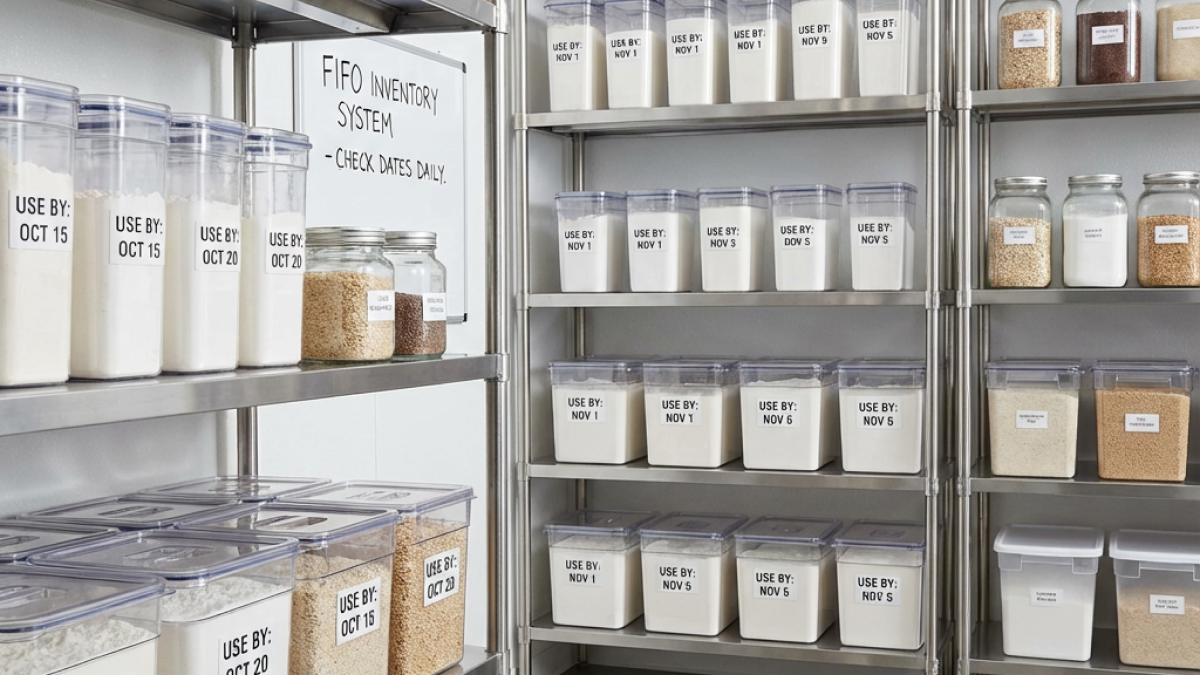
- Date everything on receipt (use color-coded day dots)
Spoilage math: If you throw away $100 of ingredients monthly but ordering more frequently costs $30 in extra delivery fees, you still save $70.
4. Customer Returns (10-15% of total waste)
Cause: Buy-back policies, customer over-ordering, quality disputes.
Return policy options:
No returns (best for margins): "All sales final. Please order accurately."
Limited credit (compromise): "Products returned within 24 hours in sellable condition receive 50% credit toward next order."
Full buy-back (worst for waste): Avoid unless customer volume justifies it. Track return rates by customer and address chronic over-orderers directly.
Handling returned product:
- Staff meals (immediate, zero additional sale)
- Discount sale to employees
- Food rescue partnership (requires setup but builds goodwill)
- Compost (last resort, track the cost)
Waste Audit Process
Run a 2-week waste audit to establish your baseline:
Daily log:
Reason codes:
- OVR: Overproduction
- ERR: Production error
- SPL: Spoilage
- RET: Return
- QAL: Quality reject
- OTH: Other
Analysis: After 2 weeks, categorize by reason code. Attack the largest category first.
Target Benchmarks
| Metric | Poor | Average | Good | Excellent |
|---|---|---|---|---|
| Total waste % | >12% | 8-12% | 5-8% | <5% |
| Overproduction % | >5% | 3-5% | 1-3% | <1% |
| Spoilage $ monthly | >$500 | $200-500 | $100-200 | <$100 |
| Return rate | >8% | 5-8% | 2-5% | <2% |
ROI of Waste Reduction
Example: Moving from 10% waste to 5%
- Annual production cost: $175,000
- Current waste (10%): $17,500
- Target waste (5%): $8,750
- Annual savings: $8,750
That's enough to cover bakery software, upgrade equipment, or increase owner compensation.
Quick Wins (Implement This Week)
- Set a hard order cutoff time and enforce it
- Start a daily waste log (paper is fine to start)
- Date-label all incoming ingredients
- Calculate your current waste percentage
- Identify your top 3 wasted items and focus on those
Generate exact production quantities from orders and track waste automatically. See how Diced OS helps bakeries cut waste by producing exactly what's ordered.
Related posts

Food Waste Reduction in Bakeries: Cut Costs by 20% with Smart Inventory Management

FEFO Inventory Rotation for Bakeries: Reduce Waste Without Slowing Production
Bakery Weather-Based Demand Planning: Turn Forecasts Into Better Daily Production
Cycle Counting for Bakery Inventory (No More Full Counts)