Bakery Par Levels and Safety Stock: A Practical Guide
Published: February 22, 2026
Many bakeries run inventory on instinct. That works until one late flour delivery or one large wholesale order pushes production off schedule.
Par levels and safety stock give your team a repeatable way to buy the right amount at the right time.
What par level means in a bakery
A par level is your target on-hand quantity for an ingredient. It should cover expected usage during your reorder cycle plus a buffer.
Think of par as the quantity that keeps production stable between deliveries.
What safety stock actually protects
Safety stock is not extra inventory for comfort. It is a risk buffer for:
- demand spikes
- supplier delays
- receiving errors
- yield loss in production
Without safety stock, one variance can force substitutions, emergency buys, or missed deliveries.
Step 1: Start with usable daily demand
Pull 8 to 12 weeks of usage by ingredient and convert to daily averages.
Example:
- Bread flour: 120 lbs/day average
- Butter: 35 lbs/day average
- Active dry yeast: 4 lbs/day average
Then calculate demand variability. A simple proxy is your high-day usage minus average-day usage.
Step 2: Confirm supplier lead time by item
Use real lead time from PO to received inventory, not what the vendor sales sheet says.
Track:
- minimum lead time
- typical lead time
- worst-case lead time
If your “2-day” flour vendor actually lands in 3 to 4 days twice per month, your model must use that reality.
Step 3: Calculate safety stock
A bakery-friendly formula:
` Safety stock = (Max daily usage × Max lead time) - (Average daily usage × Average lead time) `
This is simple, explainable, and usually good enough for operational planning.
Step 4: Calculate reorder point
` Reorder point = (Average daily usage × Average lead time) + Safety stock `
When on-hand quantity reaches the reorder point, place the order.
Step 5: Set par level
For bakeries ordering multiple times per week:
` Par level = (Average daily usage × Reorder cycle days) + Safety stock `
If you order butter every 4 days, use 4 reorder-cycle days.
Worked example: butter
Assume:
- average daily usage: 35 lbs
- max daily usage: 48 lbs
- average lead time: 3 days
- max lead time: 5 days
- reorder cycle: 4 days
Safety stock: ` (48 × 5) - (35 × 3) = 240 - 105 = 135 lbs `
Reorder point: ` (35 × 3) + 135 = 240 lbs `
Par level: ` (35 × 4) + 135 = 275 lbs `
Operational rule:
- At 240 lbs on hand, reorder.
- Target refill to 275 lbs.
Separate A, B, and C ingredients
Don’t apply the same policy to everything.
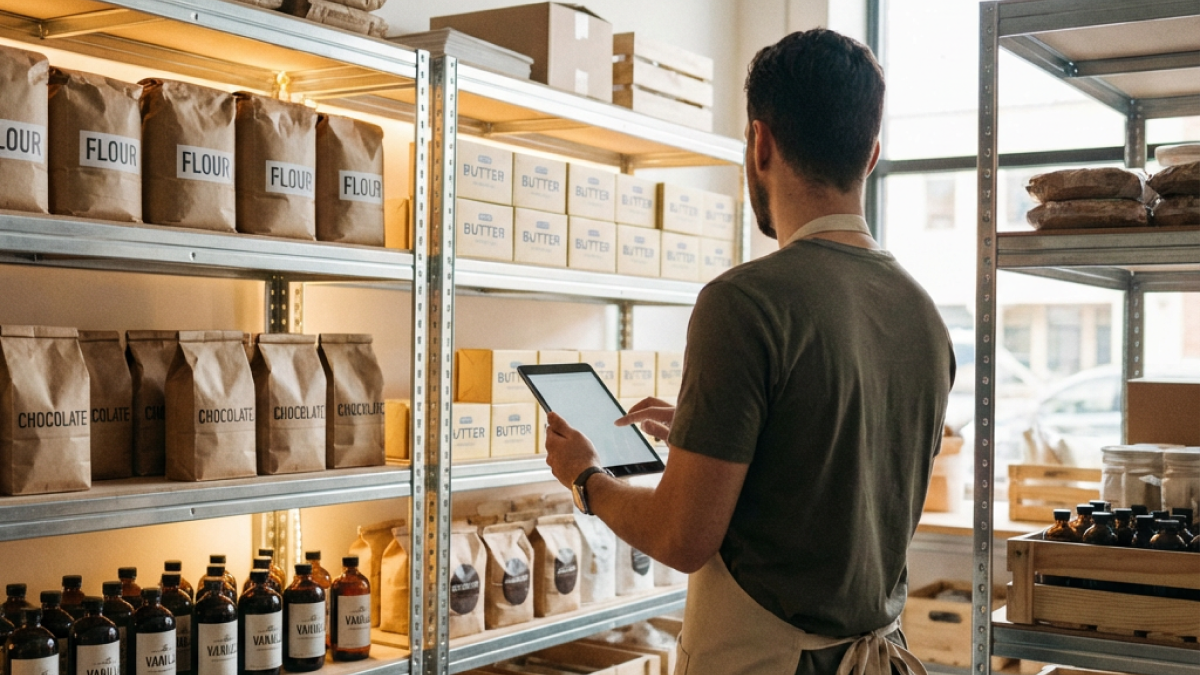
- A items: high value or critical to production (butter, specialty chocolate)
- B items: medium impact
- C items: low cost or easily substituted
Use tighter controls for A items and lighter controls for C items.
Common mistakes that inflate inventory
- using case counts without converting to usable units
- ignoring prep loss and trim
- counting inbound POs as available before receiving
- never recalculating seasonally
If your spring and holiday product mix changes, par levels must change too.
KPIs to manage weekly
Track these five metrics by ingredient class:
- stockout incidents
- emergency purchase spend
- days on hand
- waste/spoilage percentage
- fill rate on production requisitions
If stockouts stay high while days-on-hand is also high, your par logic is wrong, not just your buying discipline.
Implementation checklist
- Build a sheet with average usage, max usage, lead times, and pack-size conversions.
- Calculate safety stock and reorder point for top 20 ingredients.
- Convert to receiving-friendly order quantities.
- Train production and receiving teams on reorder triggers.
- Review every 30 days.
Par levels are not a one-time setup. They are a control loop.
Try Diced OS to set ingredient par levels, track on-hand inventory, and trigger smarter reorders. Diced OS
Related posts

FEFO Inventory Rotation for Bakeries: Reduce Waste Without Slowing Production
Mastering Bakery Inventory Management for Wholesale Success
Par-Baked and Frozen Dough Inventory for Bakeries: Control Stock Without Losing Freshness
Bakery Standing Orders for Wholesale Accounts: Keep Recurring Deliveries Accurate