Bakery Labor Standards by SKU: Know Which Products Eat the Schedule
Published: May 19, 2026
Two products can have the same ingredient cost and completely different profit.
One moves through the line quickly. The other needs hand finishing, special packaging, extra proofing checks, and a senior baker watching every step. If you only track ingredient cost, those products look similar. If you track labor by SKU, the truth shows up.
Labor standards help bakeries understand how much time each product should take under normal conditions.
What a Labor Standard Is
A labor standard is the expected labor time required to make one batch or unit of a product.
It is not a weapon for blaming staff. It is a planning tool.
Use labor standards to:
- price products more accurately
- build production schedules
- identify bottlenecks
- compare actual labor against expected labor
- decide which SKUs are too complex for their margin
The goal is better decisions, not stopwatch pressure.
Start With Production Steps
Break each SKU into the work that actually happens.
Example for a filled croissant:
- scale ingredients
- mix dough
- laminate
- cut and shape
- proof
- bake
- fill
- finish
- pack
- clean down
Some steps are shared across products. Others are SKU-specific. The more custom the work, the more carefully you should track it.
Measure in Batches First
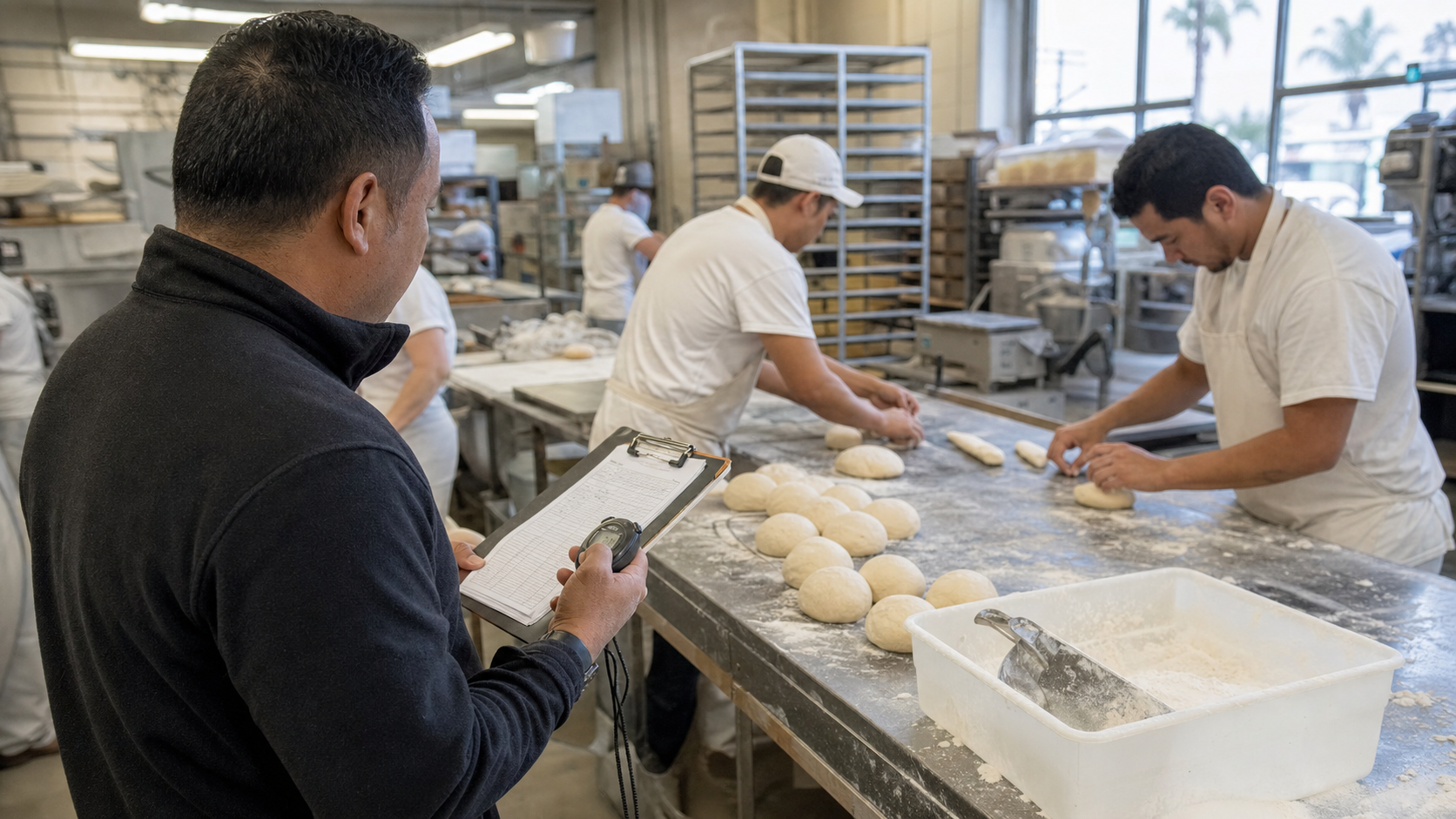
Do not start with per-unit guesses. Time the batch.
For each SKU, record:
- batch size
- number of people involved
- active labor minutes
- waiting time that does not require attention
- setup and cleanup time
- packaging time
Example:
| Step | People | Active Minutes | Labor Minutes |
|---|---|---|---|
| Mix and scale | 1 | 18 | 18 |
| Shape | 2 | 35 | 70 |
| Fill and finish | 2 | 22 | 44 |
| Pack | 1 | 16 | 16 |
| Cleanup | 1 | 10 | 10 |
Total labor minutes: 158.
If the batch yields 120 sellable units, labor is 1.32 minutes per unit.
Convert Labor Time to Cost
Use your loaded labor rate, not just hourly wage.
Loaded labor includes:
- base wage
- payroll taxes
- workers compensation
- benefits or paid time off allocation
- supervisor coverage when relevant
Formula:
Labor cost per unit = labor minutes per unit x loaded labor cost per minute
If loaded labor is $24 per hour, that is $0.40 per minute. A product requiring 1.32 minutes of labor has $0.53 in labor per unit before ingredients, packaging, overhead, and delivery.
Find Products With Labor Creep
Labor creep happens when a product slowly becomes more complex without a pricing review.
Warning signs:
- new finishing steps were added
- packaging changed from bulk to individual
- a customer requested special handling
- yield dropped but batch time stayed the same
- only one experienced person can make the item
These products are easy to keep selling because the team knows them. They are also easy to underprice.
Use Labor Standards in Scheduling
Labor standards make production planning more realistic.
If tomorrow's orders require 2,400 expected labor minutes and you have 5 people for 8 hours, you have 2,400 available minutes before breaks, meetings, and cleanup. That schedule is already full. Any rush order will push overtime or quality risk.
Better planning starts when expected work is visible before the shift begins.
Review Standards Quarterly
Labor standards are not permanent.
Review them when:
- a recipe changes
- equipment changes
- batch sizes change
- packaging changes
- a product moves from retail to wholesale
- actual labor is consistently higher than expected
Keep the standard stable enough to be useful, but not so stale that it becomes fiction.
Try Diced OS
Diced OS helps bakery teams connect recipes, costs, vendors, and production planning so product decisions are based on real operating data.
Try Diced OS to understand which products deserve more attention, better pricing, or a simpler workflow.
Related posts
Bakery Preventive Maintenance Calendar: Stop Equipment Issues Before the Rush
Bakery Batch Record Template: Capture What Actually Happened in Production
Bakery Prep List by Station: Keep Mixing, Shaping, Baking, and Packing in Sync
Bakery Production Variance Report: Compare Planned vs. Actual Output