

How to Control Labor Cost in a Wholesale Bakery
Published: June 12, 2025
In most bakeries, labor cost exceeds ingredient cost. You might spend 25-30% of revenue on ingredients and 30-40% on labor. That makes labor your single biggest variable expense.
But here's the thing: "controlling" labor cost doesn't mean cutting staff, reducing wages, or working people harder. It means getting more production from the hours you're paying for. It means eliminating wasted motion, inefficient scheduling, and process friction.
The bakeries I've seen master labor cost aren't sweatshops. They're well-organized operations where skilled people can do their best work without fighting their environment.
Understanding Bakery Labor Cost Percentage
The Basic Calculation
Labor Cost % = (Total Labor Cost / Total Revenue) × 100
Include everything:
- Wages and salaries
- Payroll taxes
- Benefits (health, retirement)
- Workers' comp insurance
- Overtime premium
Target Ranges
Retail bakeries: 30-40% of revenue Wholesale bakeries: 25-35% of revenue High-volume production: 20-30% of revenue
Wholesale should be lower than retail because you're not staffing a front counter all day. Your production is batch-oriented, not on-demand.
Why Wholesale Is Different
Retail labor includes significant customer-facing time. Selling, answering questions, boxing items, running register—these activities don't scale with volume. You need someone at the counter whether you serve 50 or 150 customers.
Wholesale labor is primarily production-focused. You're making items in larger batches, packing them efficiently, and shipping to accounts. More of your labor dollar goes directly into product.
This is the efficiency opportunity in wholesale—if you capture it.
The Three Levers of Labor Cost
Labor cost comes down to three variables:
Hours worked: Total time on the clock Rate per hour: What you pay for that time Output per hour: What you produce during that time
Most bakeries focus on the first two. The third is where the real opportunity lies.
Hours Worked
The obvious lever. Fewer hours = lower cost. But cutting hours below what production requires means:
- Quality suffers
- Stress increases
- Turnover rises
- You burn out
Hours should match genuine production needs—no more, no less.
Rate Per Hour
Paying less seems attractive until you realize:
- Skilled bakers command market rate
- Below-market wages increase turnover
- Training new people costs more than retention
- Quality correlates with skill
Pay fairly. Look elsewhere for savings.
Output Per Hour
This is where efficient bakeries excel. If one baker produces 100 croissants per hour and another produces 80, the first baker's labor cost per croissant is 20% lower—at the same hourly wage.
Improving output per hour is the sustainable path to labor cost control.
Batching for Efficiency
Wholesale production should be batched, not item-by-item.
The Setup Cost Problem
Every production run has setup time:
- Gather ingredients
- Set up equipment
- Calibrate temperatures
- Clean afterward
Making 20 croissants has almost the same setup time as making 100. But if you spread 100 croissants across five separate production runs, you're doing setup five times.
Smart Batching Principles
Maximize batch size within quality limits. Bread dough can scale significantly before handling becomes impractical. Laminated dough has optimal batch sizes based on sheeter capacity.
Consolidate similar products. Make all your laminated items on the same days. Group cookie varieties in single baking sessions. Batch sourdough production.
Match batch rhythm to order rhythm. If wholesale orders ship three times per week, batch production around those shipments rather than daily for everything.
Example: Croissant Production
Inefficient approach:
- Monday: 48 croissants
- Wednesday: 48 croissants
- Friday: 48 croissants
- Three setups, three clean-ups, 144 croissants
Efficient approach:
- Tuesday: 144 croissants (shape, proof, retard overnight)
- Wednesday: Bake all 144, pack for shipments
- One setup, one clean-up, 144 croissants
Labor time might drop 30-40% for the same output.
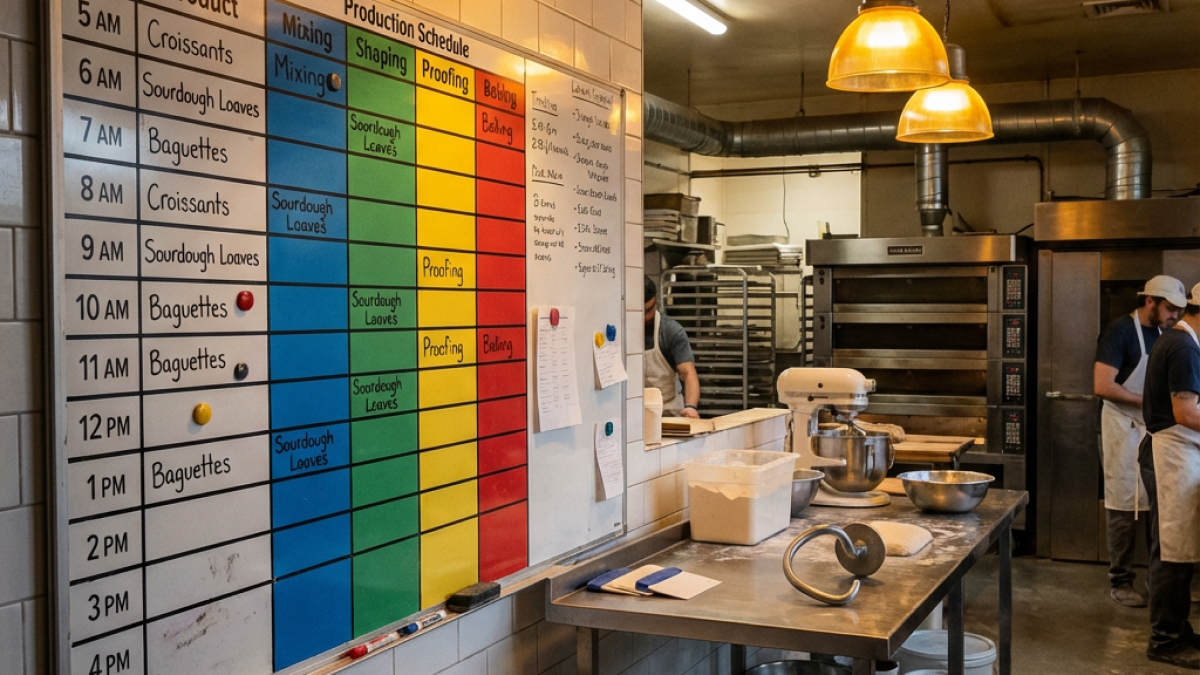
Scheduling Optimization
Scheduling poorly is expensive. The right person needs to be there at the right time.
Match Labor to Workload
Your workload isn't constant through the week:
- Orders might concentrate Monday/Thursday
- Prep might concentrate days before shipments
- Deep cleaning might happen during slow periods
Schedule labor to match. If Wednesday is a 12-hour production day and Monday is a 6-hour day, schedule accordingly—don't average to 9 hours daily.
Skill-Based Scheduling
Not all tasks require your most skilled (expensive) people:
- Scaling ingredients: Entry-level
- Mixing doughs: Moderate skill
- Lamination: High skill
- Shaping croissants: High skill
- Packing finished goods: Entry-level
Schedule skilled bakers for skilled work. Schedule entry-level staff for entry-level tasks. Paying $25/hour for someone to pack boxes wastes money.
Minimize Overtime
Overtime costs 1.5x regular time. At $20/hour regular:
- 45 hours = $800 + $150 overtime = $950
- Two people × 22.5 hours each = $900
Splitting hours between two people can be cheaper than overtime with one.
Avoid Scheduling Gaps
If you need 8 hours of baking and 4 hours of packing, scheduling them with a gap between creates waiting time. Sequence tasks so one flows into the next.
Production Efficiency Tactics
Beyond batching and scheduling, specific tactics improve output per hour.
Prep Ahead
Time spent gathering ingredients during production is time not spent producing. Prep the day before:
- Scale dry ingredients into bins
- Stage butter blocks for lamination
- Prepare pans and parchment
- Set out specialty items
When production starts, everything is ready.
Equipment in Right Places
Motion studies sound corporate, but they matter. If your baker walks 50 feet from mixer to bench 30 times per shift, that's 1,500 feet of walking. Move the bench closer: 1,000 feet saved.
Arrange the kitchen for flow:
- Mixing area → proofing area → shaping area → baking area → packing area
Minimize backtracking.
Right Tools Available
Missing a bench scraper means someone walks to get one. That's 30 seconds. Multiply by 20 occurrences per day across five bakers: 50 minutes lost.
Keep tools where they're used. Duplicate tools at different stations if needed. A $10 bench scraper pays for itself in minutes.
Standardize Processes
When everyone does tasks their own way, consistency suffers and training takes longer. Document standard methods for:
- Mixing sequences
- Shaping techniques
- Portioning
- Packing procedures
Standardization isn't about restricting creativity—it's about ensuring baseline efficiency.
The Prep vs. Production Split
Many bakeries blur prep and production. Separating them can improve both.
Dedicated Prep Shifts
Prep tasks (scaling, measuring, preliminary prep) often don't require your highest-skilled people or your best production hours.
Consider:
- Early morning prep shifts (lower-cost labor)
- Evening prep for next-day production
- Dedicated prep person during production
What Belongs in Prep
- Scaling all ingredients for the day's recipes
- Preparing mixes (crumble, streusel)
- Portioning butter for lamination
- Preparing pans and molds
- Making sub-recipes (pastry cream, frangipane)
What Belongs in Production
- Mixing and fermentation
- Lamination
- Shaping
- Baking
- Finishing and packaging
The handoff should be clean: prep delivers everything production needs, production focuses on production.
Tracking Labor Productivity
You can't improve what you don't measure.
Key Metrics
Units per labor hour: Total units produced ÷ total production hours
Labor cost per unit: Total labor cost ÷ total units
Bakery labor cost percentage: Total labor cost ÷ total revenue
Track these weekly or monthly. Look for trends.
Product-Level Tracking
Some products are inherently more labor-intensive:
- Croissants: High (lamination, shaping)
- Cookies: Low (scoop and bake)
- Decorated cakes: Very high
Know your labor cost per unit for major products. Use this for pricing decisions.
Shift-Level Tracking
Different shifts and different people produce different results:
- Is the Tuesday crew more efficient than Thursday?
- Is morning production faster than afternoon?
- Do certain product combinations batch better?
Data reveals optimization opportunities.
The Human Element
All efficiency tactics must account for human reality.
Sustainable Pace
Pushing people to maximum speed all day creates:
- Burnout
- Injuries
- Quality problems
- Turnover
Efficient isn't the same as frantic. A sustainable pace maintained over a full shift outperforms sprinting that leads to afternoon exhaustion.
Skill Development
Investing in training pays labor cost dividends:
- Skilled people work faster
- Fewer mistakes mean less waste
- Cross-training enables flexible scheduling
- Development improves retention
Cutting training budgets to save money usually increases labor cost long-term.
Equipment Investment
Sometimes the path to lower labor cost is higher equipment investment:
- A sheeter reduces lamination time 50%
- A dough divider speeds portioning
- A proofer improves consistency (less rework)
Calculate the payback: if equipment saves 10 hours weekly at $20/hour, $200/week saved pays for equipment within months.
Building a Labor-Efficient Culture
Ultimately, labor efficiency comes from everyone buying in.
Transparency
Share labor cost data with your team. Not to pressure them—to involve them.
"Last month we hit 32% labor cost. Our target is 28%. Ideas for how we can get there?"
People who understand the goal contribute to achieving it.
Incentive Alignment
Consider productivity bonuses when targets are met. If your labor cost drops from 32% to 28% on $50,000 monthly revenue, that's $2,000 saved. Sharing even $500 with the team rewards the behavior you want.
Continuous Improvement
Make efficiency a topic of regular discussion:
- Weekly production meetings: What slowed us down? What could we improve?
- After-action reviews: When something goes wrong, why?
- Suggestion capture: Track and implement team ideas
Small improvements compound over time.
Taking Action
Start with measurement. Calculate your current bakery labor cost percentage. Track it monthly.
Then pick one area:
- Batch production differently
- Optimize scheduling
- Improve prep separation
- Invest in equipment
Implement the change. Measure the result. Adjust and continue.
Labor cost control isn't a one-time project. It's an ongoing practice. The bakeries that excel at it are the ones that keep paying attention.
Want to track labor costs alongside ingredient costs and margins? Visit dicedos.com to see how our platform helps wholesale bakeries understand their true cost picture and identify efficiency opportunities.
Related posts

Bakery Packaging Cost Control: Track Boxes, Bags, and Labels Like Ingredients
Bakery Energy Cost Control Playbook: Lower Utility Spend Without Slowing Output
The Best Wholesale Bakery Management Software for 2025

Top 5 Features to Look for in Bakery Management Software