
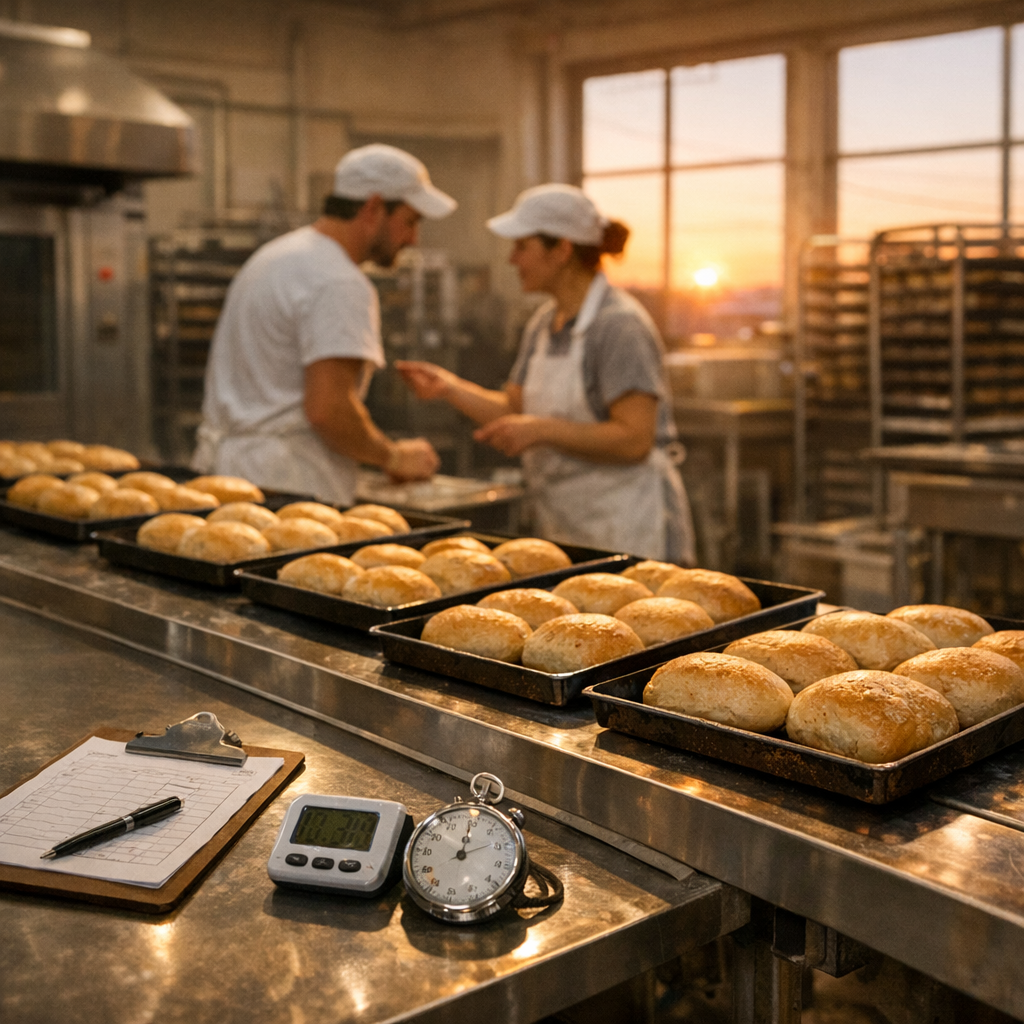
Bakery Line Balancing for the Morning Bake
Published: February 18, 2026
The morning bake is where most bakeries lose time and margin. One station is buried while another waits. The result is overtime, late deliveries, and inconsistent quality. Line balancing fixes that by matching the pace of each step to your true demand.
This guide shows a simple way to balance the morning bake using takt time, work content, and a few practical reassignments.
Start with your true demand
Line balancing only works if you know what you must produce by the cutoff time.
Calculate:
- Total units due by delivery cutoff
- The time window available for the morning bake
Example:
- 1,200 units due by 8:00 a.m.
- Production window: 4:00 a.m. to 7:30 a.m. (3.5 hours or 210 minutes)
Takt time = 210 minutes / 1,200 units = 0.175 minutes per unit (10.5 seconds per unit).
That is your target pace across the whole line.
Map the work content by step
Write the steps that touch every unit in the morning bake. Keep it simple and use averages.
Typical steps:
- Mix and scale
- Divide and shape
- Proof and load
- Bake and unload
- Cool and finish
- Pack and stage
Time each step for a small sample and convert to seconds per unit. You do not need perfect precision; you need a directional view of where time piles up.
Find the true constraint
The step with the longest seconds per unit is your constraint. In most bakeries this is proofing or oven time, but packing and staging can surprise you.
Ask two questions:
- Which step has racks waiting for it?
- Which step runs past the cutoff even when everything else is caught up?
That step defines the line pace. Everything else must align to it.
Balance the line with three levers
You have only three reliable ways to balance a line without buying new equipment.
1. Reallocate people
Move one person from a non-constraint step to the constraint. Even a 10% improvement at the bottleneck raises total output.
Check for hidden slack:
- A station with frequent idle time
- Two people doing a task that one can complete within takt
2. Split or merge tasks
Break a long task into two short tasks that can run in parallel. Or combine two tiny tasks into one station.
Example:
- Split finishing into glazing and boxing
- Combine label application with pack-out
3. Shift work earlier
If a station cannot be balanced during the bake window, pre-build part of the work the day before.
Common pre-work:
- Pre-scaling inclusions
- Pre-making fillings
- Staging packaging materials
Use a quick line balance worksheet
Build a one-page worksheet with these columns:
- Step name
- Seconds per unit
- People assigned
- Effective seconds per unit (seconds per unit divided by people)
Your target is to get every step at or below takt time. The bottleneck should be close to takt, and every other step should be slightly faster.
If one step is far above takt, balance is not possible without either more people or less scope.
Protect quality while you speed up
Line balancing should not trade away quality. Add quality checks at the constraint, not at the end.
Effective checkpoints:
- Dough temperature after mix
- Proof height before loading
- Internal temp or color at bake unload
This keeps the line from running fast but wrong.
Measure the right KPIs
Track these weekly to confirm the balance is working:
- On-time completion of the morning bake
- Overtime hours for bake staff
- Rack wait time at the constraint
- Re-bakes or quality holds
If overtime drops and on-time delivery rises, the balance is holding.
Common mistakes to avoid
- Balancing for average days instead of peak days
- Moving people without updating the standard work
- Leaving packing as a late, unplanned step
- Ignoring material staging and running out of trays or bags
Line balancing only sticks when it becomes the standard, not the exception.
Put it on a schedule
Update the balance when demand shifts. A simple cadence keeps it fresh.
Suggested schedule:
- Weekly: update demand and takt time
- Monthly: retime steps with real observations
- Quarterly: review staffing and layout
This prevents slow drift back to chaos.
Try Diced OS to build bake sheets, balance labor, and hit morning deadlines. Diced OS
Related posts
Bakery Equipment Capacity Planning: Find Your Bottleneck
Bakery Prep List by Station: Keep Mixing, Shaping, Baking, and Packing in Sync
Bakery Standing Orders for Wholesale Accounts: Keep Recurring Deliveries Accurate
Bakery Lot Traceability: A Practical Recall-Ready System for Small Teams
