
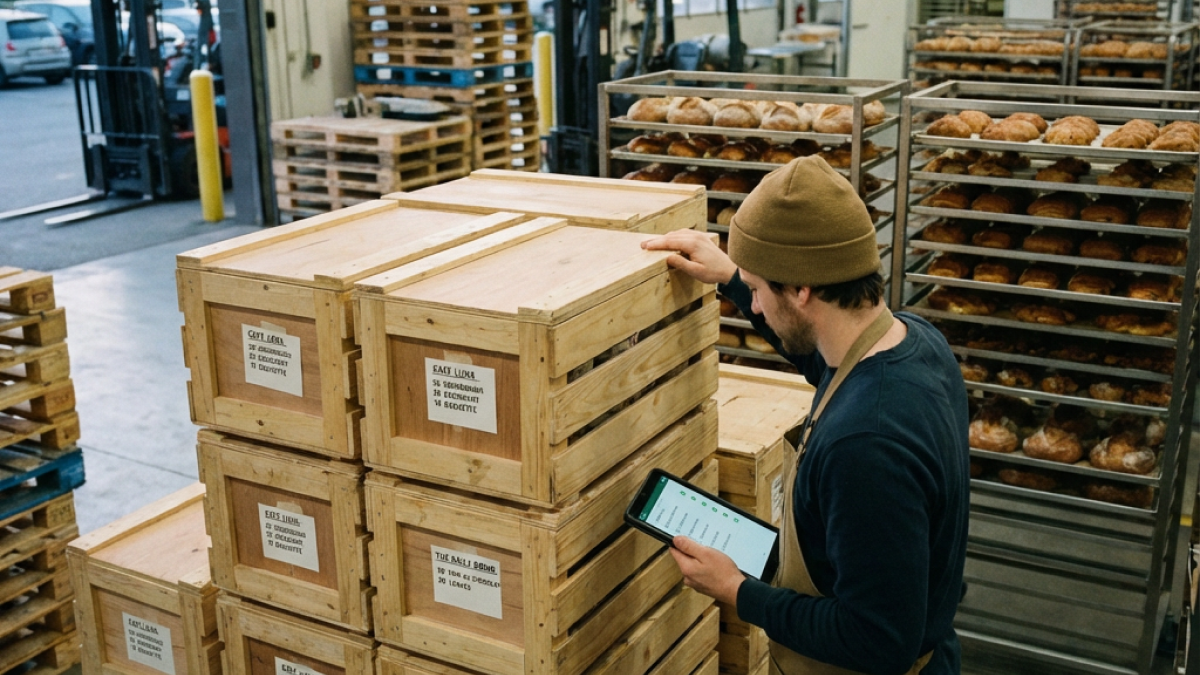
Streamlining Wholesale Bakery Operations: A Guide to Efficiency
Published: October 4, 2025
Most wholesale bakeries waste 10-15 hours weekly on tasks that could be automated or eliminated. Here's a workflow audit for each stage of operations.
Stage 1: Order Intake
Current state (if manual)
- Orders arrive via phone, text, email, and in-person
- Someone transcribes orders into a spreadsheet or notebook
- Standing orders are entered manually each week
- Order changes require phone calls to confirm
Time cost: 30-60 minutes daily (2.5-5 hours weekly) Error rate: 5-10% of orders have transcription mistakes
Streamlined workflow
Standing orders and quick entry:
- Set up recurring orders once per customer
- Orders auto-populate on designated days
- Modify or adjust through quick entry interface
- Order confirmation sent automatically
Standing orders:
- Set up once per customer
- Auto-populate weekly on designated day
- Easy to skip or modify before cutoff
Time cost: 5-10 minutes daily (modifications only) Error rate: Under 1% (system handles recurring patterns)
Weekly time saved: 2-4.5 hours
Stage 2: Production Planning
Current state (if manual)
- Pull orders from various sources
- Add up quantities by product in spreadsheet
- Calculate ingredient totals with calculator
- Handwrite or print bake sheet
- Bakers interpret and execute
Time cost: 45-90 minutes daily Error rate: 3-5% calculation errors
Streamlined workflow
Automated bake sheet:
- System pulls all orders for production date
- Auto-aggregates quantities by product
- Calculates ingredient requirements
- Generates printable bake sheet
- Creates pack lists by customer
Time cost: 5 minutes (review and print) Error rate: 0% (math is automated)
Weekly time saved: 4-6 hours
Stage 3: Production
Common inefficiencies
- Bakers wait for instructions
- Recipe questions interrupt flow
- Batch sizing done by guesswork
- No tracking of actual vs. planned output
Streamlined production day
| Time | Task | Who |
|---|---|---|
| Shift start | Bakers pick up printed bake sheet | Production lead |
| Prep pulls ingredients per sheet | Prep cook | |
| First 30 min | Scale ingredients for first batches | Baker |
| Ongoing | Mark items complete on sheet | Baker |
| End of shift | Note any variances (over/under production) | Production lead |
Digital recipe access:
- Tablets in production showing recipes
- Touch to scale up/down
- No paper recipes to dirty or lose
Production tracking:
- Mark batches complete as they finish
- System calculates actual output
- Variance flagged for review
Stage 4: Packing
Current state (if manual)
- Packer works from handwritten list
- Pulls products and packs by memory
- Labels crates/boxes by hand
- Mistakes found at delivery (too late)
Error rate: 3-8% of orders have packing mistakes
Streamlined workflow
Digital packing station:
- Packer scans or selects customer
- Screen shows exactly what to pack
- Check off each item as it goes in
- System prints label when complete
- Any missing items flagged before departure
Pack slip template:
| Customer | Product | Qty | Packed ✓ |
|---|---|---|---|
| Downtown Cafe | Croissant | 24 | [ ] |
| Downtown Cafe | Baguette | 12 | [ ] |
| Downtown Cafe | Sourdough | 6 | [ ] |
Error rate: Under 1%
Stage 5: Delivery
Common inefficiencies
- Routes planned ad-hoc each morning
- Driver carries paper lists
- No confirmation of delivery
- Customer disputes unresolvable
Streamlined delivery
Route optimization:
- Group orders by geographic zone
- Sequence stops for minimum driving
- Assign orders to drivers
Driver workflow:
- Receive route with stop sequence
- Load crates in reverse delivery order
- At each stop: unload, get signature or photo
- Mark delivery complete in app
- Move to next stop
Delivery confirmation:
- Photo of delivered goods
- Digital signature (optional)
- Timestamp and GPS location
- Proof stored for disputes
Weekly Time Savings Summary
| Stage | Manual Time | Streamlined Time | Weekly Savings |
|---|---|---|---|
| Order intake | 2.5-5 hrs | 0.5 hr | 2-4.5 hrs |
| Production planning | 5-7.5 hrs | 0.5 hr | 4.5-7 hrs |
| Packing | 5-8 hrs | 4-6 hrs | 1-2 hrs |
| Delivery admin | 2-3 hrs | 0.5 hr | 1.5-2.5 hrs |
| Total | 14.5-23.5 hrs | 5.5-8 hrs | 9-15.5 hrs |
At $25/hour owner time, that's $225-387 saved weekly, or $11,700-20,100 annually.
Error Reduction Impact
| Error Type | Manual Rate | Streamlined Rate | Cost Savings |
|---|---|---|---|
| Order entry errors | 5-10% | <1% | $200-500/month |
| Production calculation | 3-5% | 0% | $100-300/month |
| Packing mistakes | 3-8% | <1% | $150-400/month |
| Delivery disputes | 2-5% | <0.5% | $50-150/month |
Total error-related savings: $500-1,350/month
Implementation Sequence
Week 1-2: Production planning Start with automated bake sheets. This is the highest-impact, lowest-resistance change.
Week 3-4: Order intake Set up standing orders for 3-5 regular customers. Expand after validation.
Week 5-6: Packing process Implement digital pack lists. Train packing staff.
Week 7-8: Delivery optimization Route planning and delivery confirmation.
Minimum Viable Setup
If full implementation feels overwhelming, start with these three changes:
- Standing order automation: Enter recurring orders once, have them appear automatically
- Auto-aggregated bake sheet: System adds up all orders by product
- Digital pack lists: Checklist format to reduce packing errors
These three alone save 5-8 hours weekly.
See your operations streamlined in minutes. Start with a free bake sheet generator at dicedos.com and watch the time savings add up.
Related posts
How to Scale Your Wholesale Bakery Business Without Chaos
The Ultimate Guide to Bakery Production Planning
Bakery Prep List by Station: Keep Mixing, Shaping, Baking, and Packing in Sync
Bakery Standing Orders for Wholesale Accounts: Keep Recurring Deliveries Accurate